
Why Finding the Best Non Prescription Flea Treatment for Dogs Matters Year-Round
If you're looking for the best non prescription flea treatment for dogs right now, here are the top OTC options:
| Product | Type | Best For | Duration |
|---|---|---|---|
| Seresto Collar | Collar | Long-term prevention | Up to 8 months |
| Frontline Plus | Topical | Fleas, ticks, lice | 30 days |
| K9 Advantix II | Topical | Repels + kills fleas, ticks, mosquitoes | 30 days |
| Capstar | Oral tablet | Fast relief from active fleas | 24 hours |
| Wondercide Spray | Plant-based spray | Environmental + on-pet support | Daily reapplication |
Fleas and ticks are not just a summer problem. Ticks can stay active at temperatures as low as 40°F, and fleas thrive indoors year-round, surviving deep in carpet fibers, under furniture, and in pet bedding long after the weather turns cold.
Here's something that surprises most dog owners: only about 5% of a flea infestation actually lives on your dog. The other 95%, eggs, larvae, and pupae, are hiding in your home and yard.
That means even if your dog never sets foot outside, they can still pick up fleas. And if you spot one flea, there are likely hundreds more you can't see.
The good news? You don't need a vet prescription to protect your dog effectively. There are several safe, regulated, and proven OTC options available at pet stores and online, from long-lasting collars to fast-acting oral tablets to monthly topicals.
This guide breaks down exactly what's available, how each product works, and how to choose the right one for your dog's lifestyle, size, and health needs.
I'm Nabilah Shamseddine, a wellness-focused franchise entrepreneur and leader at BARKology Wellness, where I've built a deep understanding of what dogs need to look, feel, and live their best, including navigating the best non prescription flea treatment for dogs for a wide range of breeds and lifestyles. With that foundation, let's walk through everything you need to make a confident, safe choice for your pup.
Best non prescription flea treatment for dogs word guide:
How to Choose the Best Non Prescription Flea Treatment for Dogs
Finding the perfect over-the-counter (OTC) flea treatment is not a one-size-fits-all process. What works wonders for a tiny apartment-dwelling Chihuahua might be completely inadequate for an outdoor-loving Golden Retriever. To make a smart choice, we must look closely at our dog’s unique profile.
First, consider your dog’s age and weight. Dosing is highly specific; applying a large-dog treatment to a small pup can lead to dangerous toxicity, while under-dosing a giant breed will leave them completely unprotected.
Breed size and coat type also play a massive role. Long-haired, double-coated breeds like Akitas or Huskies require careful application of topical treatments to ensure the medicine actually reaches the skin rather than sitting uselessly on top of their dense undercoat. Furthermore, certain breeds carry genetic sensitivities. For example, dogs with the MDR1 gene mutation (common in Collies, Australian Shepherds, and Shetland Sheepdogs) require extra caution with specific medications, although many modern OTC products are tested and proven safe for them.
Medical history is another crucial factor. If your dog has a history of seizures or neurological conditions, you must avoid certain classes of flea preventives (like oral isoxazolines) and consult a vet. For pregnant or lactating dogs, always double-check the label or speak to a professional, as many chemical treatments can pass to puppies.
Finally, geography dictates parasite pressure. In Tampa, FL and South Tampa, FL, our warm, humid climate is an absolute paradise for fleas and ticks. Unlike northern states where winter freezes halt the flea cycle, Florida dogs face relentless, year-round pest pressure.
Whether your dog spends their days lounging indoors or hiking through local trails, they are susceptible to flea allergy dermatitis (FAD), where a single flea bite can trigger intense itching, hair loss, and secondary skin infections. Always read label directions carefully and seek veterinary guidance when in doubt.
Best Non Prescription Flea Treatment for Dogs by Lifestyle
To narrow down your search, let's look at how your dog's daily routine affects their preventative needs:
- Apartment Dogs & Couch Potatoes: If your pup only goes out for quick bathroom breaks on the pavement, their risk is lower, but still present. A gentle monthly topical or a long-lasting collar is often plenty.
- Dog Park & Wooded Trail Adventurers: Dogs that run through tall grasses, play with other pets, or explore wooded areas in the Tampa area are at high risk for both fleas and ticks. They need a heavy-duty option that both kills and repels, such as K9 Advantix II.
- Water Lovers & Frequent Swimmers: If your dog loves the beach or gets bathed weekly at our South Tampa grooming salon, topical treatments can wash off prematurely if not fully dried. An oral pill or a highly water-resistant collar is a better fit.
- Picky Eaters & Sensitive Stomachs: If your dog turns their nose up at chewable tablets or experiences vomiting after oral meds, topical spot-ons or collars are the way to go.
- Multi-Pet & Cat Households: If your dog shares bedding with or grooms a feline sibling, you must be extremely careful. Many highly effective dog topicals contain ingredients like permethrin, which are highly toxic to cats.
Safety Checks Before Buying the Best Non Prescription Flea Treatment for Dogs
Before clicking "add to cart," run through this safety checklist:
- Check the Species: Never use a dog product on a cat, or vice versa.
- Verify the Weight Band: Weigh your dog recently. Do not guess. Dosing bands are strict.
- Confirm Minimum Age: Most OTC preventives require puppies to be at least 8 weeks old.
- Look for Regulation Labels: Safe, legal OTC treatments are regulated by the Environmental Protection Agency (EPA) for topicals/collars, or the Food and Drug Administration (FDA) for oral medications.
- Understand the Side Effects: Watch for neurological warnings, skin irritation, vomiting, lethargy, or tremors. If you observe any of these, wash the product off immediately and contact a vet.
- Avoid Counterfeits: Buy only from reputable sellers. Counterfeit flea collars and topicals are common on discount online marketplaces and can contain dangerous, unregulated chemicals.
The Best OTC Flea Treatment Options for Dogs, Ranked by Use Case
To help you compare the top options, we’ve laid out the leading over-the-counter options on the market. For more details on popular choices, you can read The Best Flea Treatments for Dogs and Cats - GoodRx to see how they stack up.
| Product | Format | Target Parasites | Speed of Kill | Duration | Best Use Case |
|---|---|---|---|---|---|
| Seresto | Collar | Fleas, larvae, ticks | Fleas: 24 hours / Ticks: 48 hours | 8 months | Long-term, low-maintenance prevention |
| Frontline Plus | Topical | Fleas, eggs, larvae, ticks, lice | 12 hours | 30 days | Standard monthly prevention, safe for swimmers |
| K9 Advantix II | Topical | Fleas, ticks, mosquitoes, flies, lice | 12 hours | 30 days | Dogs in high-pest areas (Florida) without cats |
| Capstar | Oral Pill | Adult fleas only | 30 minutes | 24 hours | Immediate relief during active infestations |
| Wondercide | Spray | Fleas, eggs, larvae, ticks, mosquitoes | On contact | Daily / As needed | Natural, plant-based daily support |
Best Long-Lasting OTC Flea Collar: Seresto
For busy pet owners who hate remembering monthly doses, the Seresto Flea & Tick Collar is the ultimate champion. Utilizing a slow-release matrix of imidacloprid and flumethrin, it provides up to 8 months of continuous, non-greasy protection.
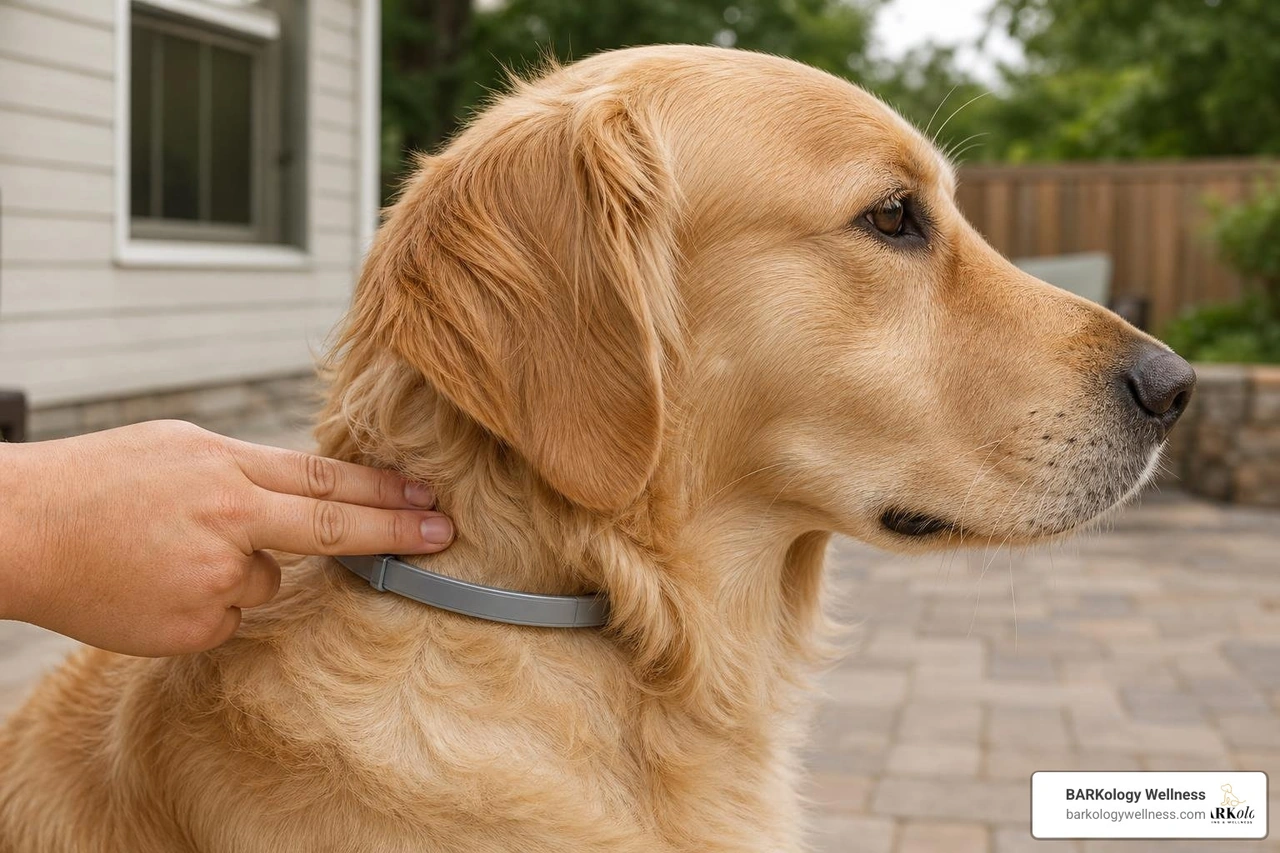
In peer-reviewed studies, Seresto demonstrated a remarkable 96.7% efficacy against fleas and 94.7% against ticks over its entire duration. To ensure it works correctly, you must follow the "two-finger rule": fit the collar snugly enough that you can only slip two fingers between the collar and your dog's neck, ensuring direct skin contact. While it is water-resistant, frequent swimming or bathing may reduce its effective timeline slightly. For more on this popular collar, check out the Amazon Best Sellers: Best Dog Flea & Tick Control list where it consistently ranks near the top.
Best Monthly OTC Topical for Fleas and Ticks: Frontline Plus
Frontline Plus is a household name for a reason. Powered by fipronil and (S)-methoprene, it targets both adult fleas and breaks the life cycle by killing flea eggs and larvae. It also tackles ticks and chewing lice.
Applied between the shoulder blades directly to the skin, it disperses through the dog's natural skin oils. You must avoid bathing your dog or letting them swim for 48 hours before and after application to ensure it fully absorbs. It can leave a temporary oily spot on the fur, but it is highly reliable.
Best OTC Topical for Repelling Ticks and Mosquitoes: K9 Advantix II
If you live in Florida, mosquitoes are an unavoidable part of life. K9 Advantix II is uniquely formulated to not only kill but actually repel fleas, ticks, and mosquitoes before they can bite. It contains imidacloprid, permethrin, and pyriproxyfen.
Critical Warning: Because it contains permethrin, K9 Advantix II is highly toxic to cats. If you live in a multi-pet household, you must keep treated dogs separated from cats until the application site is completely dry. You can read more about this dynamic in the Top 5 Flea & Tick Preventives for Dogs & Cats (No Prescription) guide.
Best Fast-Acting OTC Oral Flea Pill for Active Fleas: Capstar
When your dog is covered in crawling fleas and scratching frantically, you don't have hours to wait. Capstar (nitenpyram) is an oral tablet that starts killing adult fleas in just 30 minutes, achieving near 100% kill rate within 4 hours.
However, Capstar is a short-term weapon. It only lasts for 24 hours and does not kill flea eggs, larvae, or ticks. It is designed to clear an active infestation immediately, but must be paired with a long-term preventive (like a collar or topical) to keep the bugs from coming back.
Best Natural or Plant-Based OTC Support Option
If you prefer to avoid synthetic chemicals, or want an extra layer of defense for your home and yard, plant-based sprays are fantastic. They use natural essential oils to kill pests physically by penetrating their exoskeletons on contact.
- GoneNaturally: This scentless, plant-based formula is perfect for dogs with sensitive skin and owners who dislike strong aromatherapy smells. It's a great choice for spraying down bedding and carpets. You can find it directly here: GoneNaturally Scentless Flea and Tick Spray for Dogs & Home. 16oz..
- Wondercide: Powered by natural essential oils (like cedarwood, lemongrass, or peppermint), Wondercide kills and repels fleas, ticks, and mosquitoes. It is safe for daily use on pets of all ages when used as directed. Check out their standard spray 4 oz. Flea & Tick Spray for Pets + Home | Wondercide or try the refreshing Lemongrass Flea & Tick Spray for Pets + Home | Wondercide variant.
For pets that prefer a dry application, you can also consider the All-in-One Flea Remedy Powder for Dogs & Cats | Only Natural Pet, which uses geraniol and peppermint oil in a calcium carbonate base to treat pets, carpets, and yards.
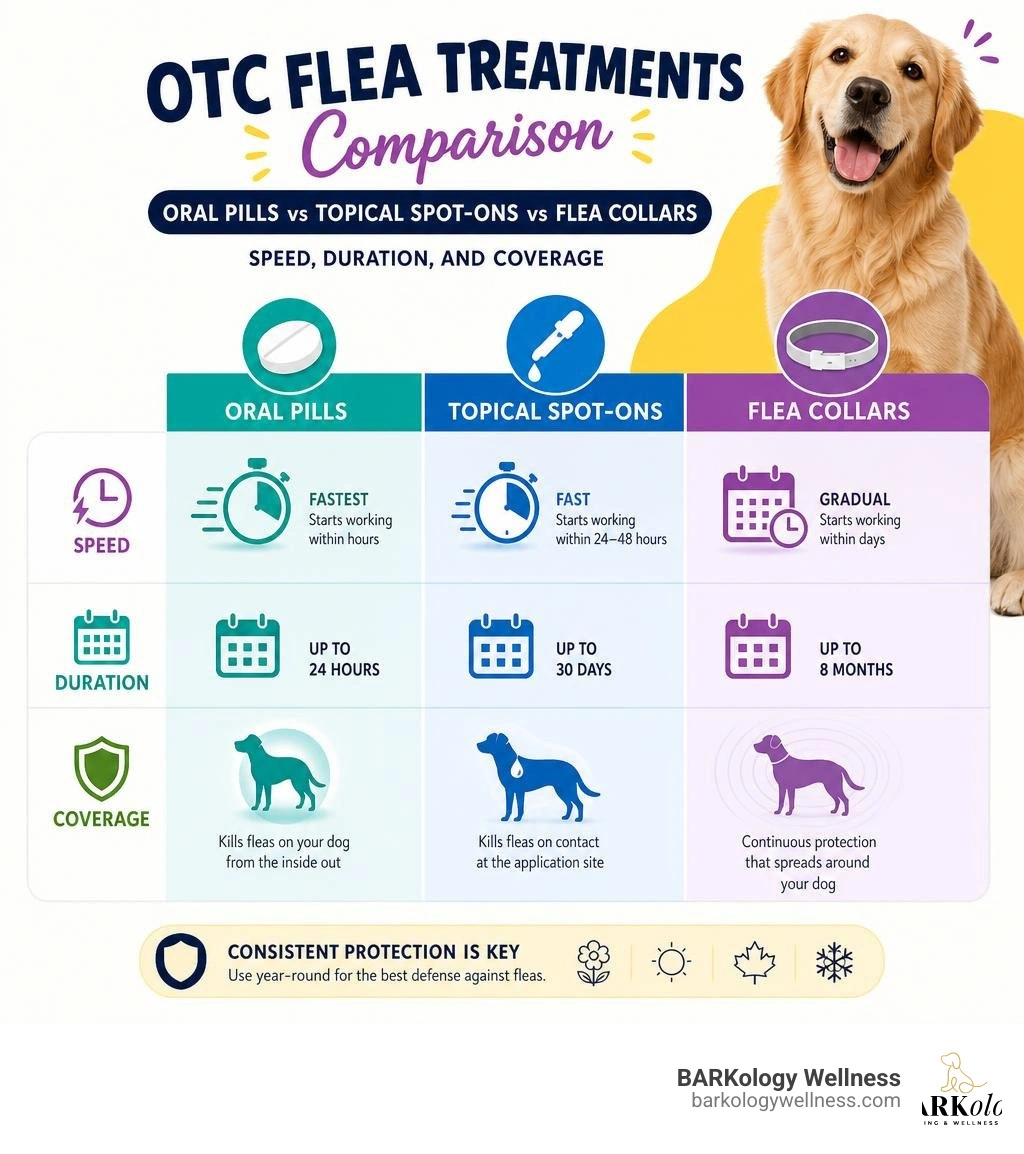
Oral Pills vs Topicals vs Collars: Which OTC Format Works Best?
Understanding how these different formats deliver medicine to your dog is key to picking the right one.
How Oral Flea Pills Work
Oral treatments like Capstar work systemically. Once swallowed, the active ingredient enters your dog's bloodstream. When a flea bites your dog, it ingests the medicine and dies rapidly.
- Pros: No messy residue on the fur; completely unaffected by swimming or frequent bathing; fast onset.
- Cons: Fleas must actually bite your dog to die (which can trigger flea allergy dermatitis); short-term OTC options don't cover ticks or eggs.
How Topical Spot-Ons Work
Topicals are applied directly to the skin, where they collect in the hair follicles and oil glands, spreading across the body via the skin's natural oils.
- Pros: Can kill fleas on contact without requiring a bite; often contains insect growth regulators (IGRs) to kill eggs and larvae; many formulations repel mosquitoes and ticks.
- Cons: Leaves a greasy spot for 24-48 hours; can wash off if the dog swims or is bathed too quickly after application; potential for skin irritation at the application site.
How Flea Collars Work
Collars release a low, continuous dose of active ingredients that distribute over the dog's skin and hair coat over several months.
- Pros: Exceptional convenience (lasts up to 8 months); highly cost-effective; reduces tick attachment.
- Cons: Must be worn constantly; can cause localized neck irritation in some dogs; risk of buying ineffective counterfeit collars online.
Treating an Active Flea Infestation on Your Dog and in Your Home
Because only 5% of fleas are on your dog, treating the dog alone will not solve an infestation. If you don't treat the environment, the remaining 95% (eggs, larvae, and pupae) will hatch and re-infest your pet in a vicious cycle.
To get a sense of how local pet owners handle this in our region, you can check out the local discussions on the Preferred tick and flea prevention for dogs in Florida? - Facebook group.
Step 1: Give Fast Relief to the Dog
Start by giving your dog an oral pill like Capstar to knock out the biting adults within minutes. Follow up with a warm bath using a gentle, soothing dog shampoo. Use a fine-toothed flea comb, dipping it in soapy water to drown the fleas you pull off. Once dry, apply a long-term preventive like a monthly topical or Seresto collar to keep new fleas from reproducing.
Step 2: Break the Flea Life Cycle Indoors
Strip all pet bedding, blankets, and removable cushion covers, washing them in hot water and drying them on high heat. Vacuum all carpets, rugs, baseboards, and under furniture daily. Crucial step: Empty your vacuum bag or canister into a sealed trash bag and take it outside immediately so larvae don't crawl back out.
For comprehensive indoor defense, a specialty kit like the Home Treatment Kit | Natural Flea & Tick Control – Wondercide is highly effective at treating carpets, upholstery, and hard-to-reach cracks.
Step 3: Reduce Outdoor Reinfection
Fleas love shady, moist soil, leaf litter, and tall grass. Keep your lawn mowed short and clear away yard debris where wildlife might drop flea eggs. Apply a pet-safe yard spray to shady patios, kennels, and dog runs to create a protective barrier.
OTC Flea Treatment Safety: Side Effects, Cat Dangers, and When to Call a Vet
While over-the-counter flea treatments are highly regulated and generally very safe, they are still active chemical or concentrated botanical formulations. You must monitor your dog closely after any application.
Common mild side effects include temporary skin redness, itching, or minor cosmetic changes at the application site. More serious reactions, which warrant an immediate call to your vet, include heavy drooling, vomiting, diarrhea, lethargy, loss of coordination (ataxia), or muscle tremors.
Why Dog Flea Medicine Can Be Dangerous for Cats
We cannot stress this enough: never use dog flea treatments on cats. Many dog topicals contain permethrin, a synthetic pyrethroid that is highly effective for dogs but incredibly toxic to cats. A cat’s liver cannot metabolize permethrin, and exposure can lead to severe muscle tremors, violent seizures, and death.
If you apply a permethrin-based product to your dog, keep them completely separated from your cats until the product is 100% dry on the skin.
Dogs Who Need Extra Caution
Some canine populations require a gentler touch:
- Puppies under 8 weeks: Their internal organs are still developing and cannot process most adult preventives safely.
- Toy Breeds & Seniors: Frail or very small dogs can be highly sensitive to chemical doses.
- Dogs with a History of Seizures: Always consult a vet before using systemic preventives.
- MDR1 Breeds (Collies, Aussies, Shelties): These dogs have a genetic mutation affecting how they process drugs, making them more vulnerable to toxicity.
Common OTC Flea Treatment Mistakes
- Bathing too soon: Washing your dog less than 48 hours after applying a topical spot-on can completely strip the medicine away.
- Guessing the weight: Guesses lead to under-dosing (ineffective) or overdosing (toxic).
- Stopping in the winter: In Tampa, FL, our winters are incredibly mild. Stopping prevention in November is the number one cause of sudden spring flea explosions!
- Stacking preventives: Never combine multiple chemical preventives (like a collar and a topical) without explicit veterinary approval.
Year-Round Flea and Tick Prevention Without a Prescription
Consistency is the absolute secret to a flea-free life. It takes up to three months to fully break a flea infestation cycle once it starts, so stopping and starting your preventive care opens up dangerous gaps.
Do You Need a Vet Prescription for Flea and Tick Medicine in the US?
In the United States, flea and tick preventives are split into two categories:
- EPA-Regulated (Over-the-Counter): These are topicals, collars, and sprays (like Seresto, Frontline, and K9 Advantix II). They do not require a prescription and can be purchased freely.
- FDA-Regulated (Prescription): Systemic chewable tablets (like NexGard, Simparica, or Bravecto) must be prescribed by a veterinarian under a valid Vet-Client-Patient Relationship (VCPR).
If you are looking for long-lasting topical solutions that are veterinary-grade, you can read more about options like the Topical Solution for Dogs - Merck Animal Health USA (which is a prescription-based 12-week topical) to discuss with your vet.
How Fast OTC Flea Treatments Work and How Long They Last
- Capstar Oral Pills: Start working in 30 minutes; last 24 hours.
- Topical Spot-Ons (Frontline, Advantix): Start working in 12 hours; last 30 days.
- Seresto Collar: Starts working in 24 hours; lasts up to 8 months.
- Natural Sprays (Wondercide, GoneNaturally): Kill on contact; require daily or weekly reapplication.
Why Consistent Prevention Matters Even in Winter
Even when temperatures dip slightly in South Tampa, our heated homes provide a cozy sanctuary for fleas. Dormant pupae can survive inside carpet fibers and baseboards for months, waiting for the vibration of a passing dog to hatch and strike. Year-round prevention keeps your dog safe from tapeworms, severe anemia, and painful skin allergies.
Frequently Asked Questions About OTC Flea Treatments for Dogs
What is the best non-prescription flea treatment for dogs overall?
It depends on your dog’s lifestyle. For long-lasting, low-maintenance protection, the Seresto Collar is unmatched. For active dogs exposed to heavy mosquito and tick pressure in Florida, K9 Advantix II is the top choice. For immediate, emergency relief during an active infestation, Capstar is the gold standard.
Can I combine oral, topical, collar, spray, or shampoo flea treatments?
You should never double up on heavy chemical treatments (e.g., do not use a Seresto collar and Frontline Plus together) as this can cause a toxic overdose. However, you can safely pair a fast-acting, short-term oral pill like Capstar with a long-term topical, or use natural, plant-based sprays like Wondercide alongside a chemical preventive for an extra layer of outdoor protection.
Can fleas go away on their own if I only treat my dog?
No. Because 95% of the flea population lives in your carpet, furniture, and yard as eggs, larvae, and pupae, only treating your dog will result in continuous reinfestation. You must treat both your pet and your environment to completely eradicate the problem.
Conclusion
Finding the best non prescription flea treatment for dogs is all about matching the right product to your dog’s weight, breed, health history, and unique lifestyle. Whether you go with the long-lasting convenience of a Seresto collar or the targeted, repelling power of K9 Advantix II, staying consistent year-round is the key to keeping your pup happy and itch-free.
At BARKology Wellness in South Tampa, FL, we believe that flea and tick prevention goes hand-in-hand with professional grooming and skin care. Regular grooming visits are the perfect opportunity for our expert stylists to perform deep skin checks, spot early signs of flea dirt, and soothe irritated skin. Schedule wellness-focused grooming support with us today to keep your dog looking and feeling their absolute best!