
Why Choosing a Certified Dog Groomer Matters for Your Pet's Health and Safety
A certified dog groomer is a trained professional who has completed formal education, passed industry-recognized exams, and demonstrated the skills needed to safely and effectively groom dogs of all breeds and coat types.
Here's what you need to know at a glance:
| Question | Quick Answer |
|---|---|
| What is a certified dog groomer? | A groomer who has earned a credential from a recognized body like NDGAA, AKC, or IPG |
| Why does certification matter? | It validates technical skill, safety knowledge, and professional standards |
| Top certifications to look for | NCMG, AKC S.A.F.E., Fear Free, AKC PGC |
| How long does certification take? | As little as 4 weeks for intensive programs; up to several months for online paths |
| Where can I find one? | Look for credentials displayed at grooming salons or ask directly before booking |
Not all groomers are created equal. Anyone can pick up a pair of clippers and call themselves a groomer, but a certified professional has proven they know how to handle your dog safely, recognize potential health issues, and deliver breed-appropriate results.
With the pet grooming industry employing over 439,400 workers and growing at 11% faster than average, the demand for qualified groomers is rising fast. So is the importance of knowing who you're trusting with your dog.
I'm Nabilah Shamseddine, franchise entrepreneur and leader at BARKology Wellness, where our commitment to premium, health-focused experiences means we hold our certified dog groomer team to the highest professional standards. In this guide, I'll walk you through everything you need to know about grooming certification, from what it means to how it protects your pet.
Key terms for certified dog groomer:
What is a certified dog groomer and Why Does Certification Matter?

In pet care, the title of certified dog groomer isn't just a label; it’s a testament to a professional's dedication to their craft. While the grooming industry in many regions remains largely unregulated, voluntary certification acts as a critical benchmark for quality and safety.
Skill Validation and Technical Proficiency
Certification serves as an objective validation of a groomer's skills. It ensures that the individual has moved beyond basic "shave-downs" to master the art of canine aesthetics. A certified professional understands the nuances of different coat types, from the silky tresses of a Yorkie to the dense double coat of a Husky. They have undergone rigorous testing to prove they can handle sharp tools around a moving, living animal without causing harm.
Breed-Specific Styling
One of the primary benefits of hiring a certified dog groomer is their deep knowledge of breed standards. If you own a Poodle, a Bichon Frise, or a Terrier, you know that their "look" is iconic. Certification programs like those offered by the National Dog Groomers Association of America (NDGAA) require groomers to demonstrate proficiency in specific breed patterns, ensuring your pet leaves the salon looking like the best version of their breed.
Health Monitoring and Safety
Beyond aesthetics, a certified professional is trained to be a first line of defense for your pet's health. During the grooming process, they perform a thorough skin and coat assessment. They are trained to spot:
- Early signs of skin infections or parasites.
- Lumps or bumps that may require veterinary attention.
- Signs of ear infections or dental issues.
Furthermore, credentials like the AKC Professional Grooming Credential focus heavily on foundational knowledge and safety. This standardized exam ensures that the groomer meets industry best practices, giving pet owners peace of mind that their furry family member is in capable hands.
Consumer Trust
For pet owners in South Tampa, choosing a salon that employs certified staff is about building a relationship of trust. When a groomer takes the time to earn a "Master Groomer" status or completes specialized safety training, it shows a level of professionalism that translates into better care for your dog. It separates the "hobbyist" from the "expert."
Top Industry Certifications for Grooming Professionals
Navigating the alphabet soup of grooming credentials can be confusing. Here are the most prestigious certifications we recognize in the industry as of April 2026.
- NCMG (Nationally Certified Master Groomer): This is the "gold standard" provided by the NDGAA. Achieving this status requires passing multiple written and practical exams across four breed groups: Non-Sporting, Sporting, Terriers, and Masters. It often takes years of dedicated work and continuing education to achieve.
- AKC S.A.F.E. Program: Standing for Safety, Assurance, Fundamentals, and Education, this American Kennel Club program focuses on salon safety protocols. Groomers must pass a comprehensive test and pledge to a strict Groomer/Salon Oath that prioritizes the pet's well-being above all else.
- Fear Free Certification: This specialized training focuses on the emotional well-being of the pet. A Fear Free certified dog groomer uses gentle handling techniques and environmental modifications (like calming music or specific scents) to reduce fear, anxiety, and stress (FAS) during the grooming process.
- IPG (International Professional Groomers): This organization offers a multi-tiered certification path, ranging from Certified Professional Groomer (CPG) to International Certified Master Groomer (ICMG). It is recognized globally and emphasizes both technical skill and safety.
- ISCC (International Society of Canine Cosmetologists): This group focuses on the "science" of grooming, including skin and coat health, dermatology, and the chemistry of grooming products.
Continuing Education Units (CEUs)
The best groomers never stop learning. Many certifications, such as the AKC Professional Grooming Credential, require renewal every five years. To maintain their status, groomers must complete at least 25 hours of continuing education units (CEUs). This ensures they stay up to date with the latest safety techniques, tool innovations, and styling trends.
The Role of a certified dog groomer in Salon Safety
Safety is the cornerstone of professional certification. A certified dog groomer is trained in:
- Sanitation: Proper cleaning of blades, shears, and tubs to prevent the spread of zoonotic diseases.
- Accident Avoidance: Understanding how to safely secure a dog on the table and in the tub to prevent falls or injuries.
- Handling Techniques: Using "least restraint" methods to keep the dog calm and cooperative.
- Emergency Response: Many certified professionals also hold Pet CPR and First Aid certifications, allowing them to act quickly if a dog experiences a medical emergency like choking or a seizure.
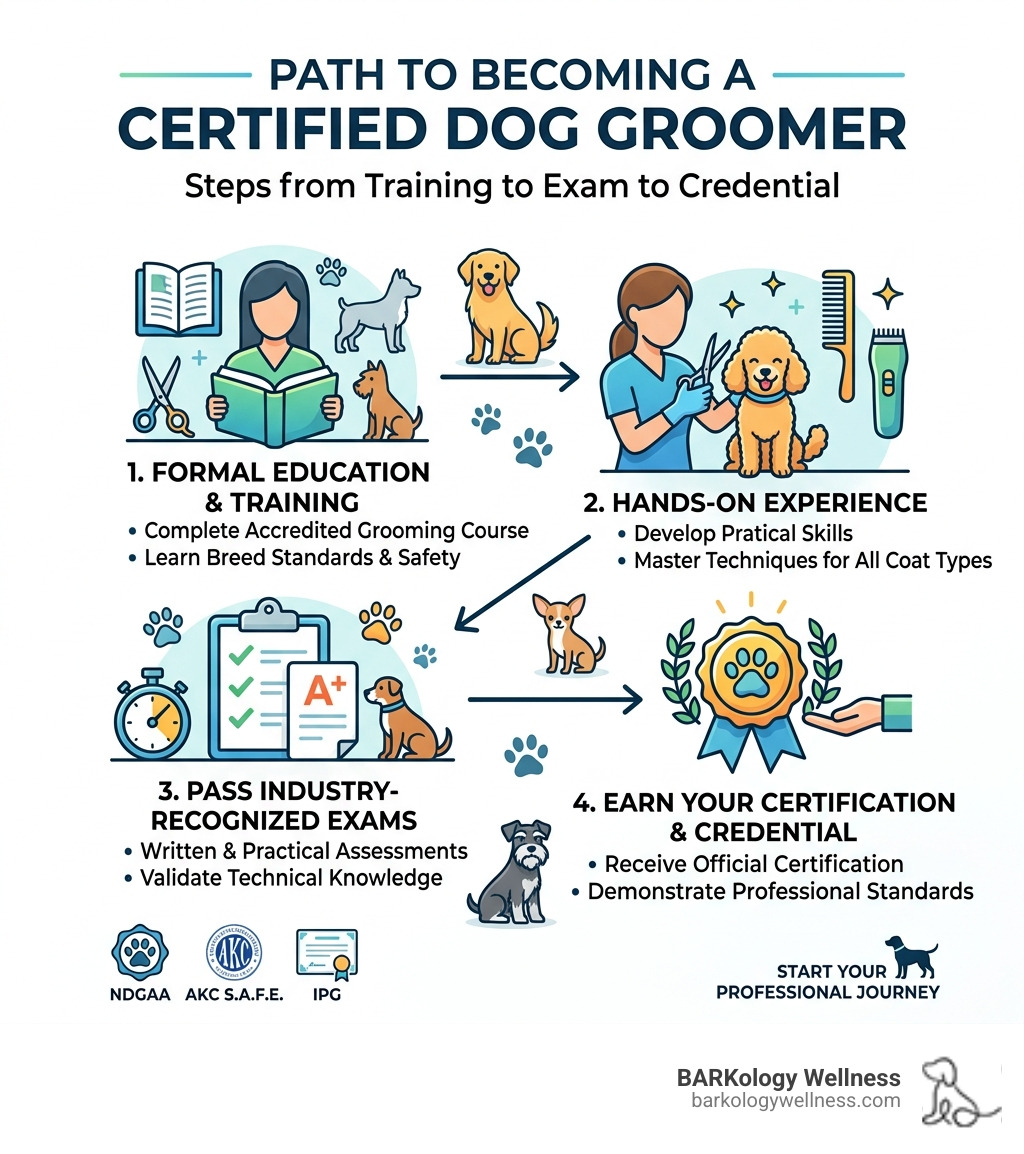
How to Become a Certified Dog Groomer: Training and Requirements
If you are looking to enter this rewarding field, the path to becoming a certified dog groomer involves a blend of education and hands-on experience. While there is no single "correct" way to start, certain paths are more respected by top-tier salons.
Intensive Training Programs
Many aspiring groomers choose 100-hour intensive programs. These are often 4-week courses that provide a deep dive into the fundamentals. These programs typically cover:
- Dog behavior and safe handling.
- Anatomy and health assessments.
- Equipment usage and maintenance.
- Bathing, drying, and prep work.
- Basic scissoring and clipping.
In-Person vs. Online Training
This is a common debate in the industry. While online courses offer flexibility and are often more affordable, they lack the immediate feedback of an instructor.
| Feature | In-Person Training | Online Certification |
|---|---|---|
| Direct Mentorship | Immediate, hands-on correction | Video-based or delayed feedback |
| Real-World Dogs | Access to various breeds provided | Student must source their own dogs |
| Equipment | Professional tools usually provided | Student must purchase everything |
| Employer Preference | High; demonstrates practical skill | Moderate; often requires a practical "test" |
| Duration | 4–12 weeks intensive | Self-paced (2–5 months average) |
The Training Path to Becoming a certified dog groomer
Beyond initial schooling, most groomers enter an apprenticeship phase. This allows them to work under a Master Groomer to refine their "eye" for balance and symmetry. To reach the highest levels of certification, such as the NCMG, a groomer must build a portfolio of work and pass timed, judged exams where their cuts are scrutinized by experts for precision and breed accuracy.
Essential Technical Skills for Every certified dog groomer
A professional curriculum isn't just about haircuts. It includes:
- Canine Anatomy: Understanding bone structure to create balanced silhouettes.
- Coat Types: Knowing which products to use for wire, wool, silk, or double coats.
- Tool Maintenance: Learning how to sharpen and care for expensive shears and clipper blades.
- Sanitary Trims: Performing delicate work in sensitive areas with precision.
- Skin Health: Identifying issues like hot spots, sebaceous cysts, or allergic dermatitis.
Career Outlook and Salary Expectations in 2026
The pet industry is booming, and the demand for a skilled certified dog groomer has never been higher. As of April 2026, the employment outlook for animal care and service workers is projected to grow by 11%, which is significantly faster than the national average for all occupations.
Salary and Earning Potential
The average salary for animal care workers sits around $33,860 per year, but this figure can be misleading for highly skilled groomers. A certified dog groomer working in a high-end salon or running a successful mobile business can earn significantly more.
- Commission-Based Pay: Many groomers earn 50% of the grooming fee plus tips.
- Per-Dog Rates: In luxury markets like Tampa, groomers can average $85 to $125 per dog.
- Throughput: A seasoned professional may see 4 to 5 dogs per day.
For those with an entrepreneurial spirit, opening a boutique salon or a mobile grooming unit can lead to even higher returns. Successful graduates of top programs often report being booked three months in advance, demonstrating the immense loyalty pet owners have for a groomer they trust.
Frequently Asked Questions about Professional Grooming
How long does it take to get certified?
The timeline varies. An intensive, in-person program can provide a foundational certificate in just 4 weeks (approx. 100 hours). However, becoming a "Master Groomer" (NCMG) is a multi-year journey that involves gaining significant field experience and passing several levels of testing.
Is online certification as good as in-person school?
Online programs, such as those from Penn Foster, are excellent for learning theory, anatomy, and business practices. However, because grooming is a tactile, physical skill, most employers, including us at BARKology, highly value hands-on experience. If you choose an online path, we recommend supplementing it with an in-person apprenticeship or internship.
How do I find a certified groomer near me?
The best way is to look for salons that proudly display their credentials. You can also search the directories of the NDGAA or look for the "AKC S.A.F.E." seal on a salon's website. In South Tampa, you can always visit us at BARKology to meet our certified team and see our standards in action.
Conclusion
At BARKology Wellness, we believe that every dog deserves the royal treatment. This isn't just about fancy bows or expensive shampoos; it’s about a holistic approach to health and happiness. By choosing a certified dog groomer, you are ensuring that your pet is handled with the expertise, safety, and compassion they deserve.
Our salons in Tampa and South Tampa provide a serene, luxury environment where your pet’s well-being is our top priority. From breed-standard styling to our specialized wellness baths, our certified professionals are here to provide the highest level of care.
Ready to see the difference professional certification makes? Book a grooming session with our expert team today and give your dog the royal treatment they deserve.