
Why Dog Brushing Matters More Than Most Owners Realize
Dog brushing is one of the simplest things you can do to protect your pet's health, yet most owners either skip it or do it wrong.
Here's a quick answer to what you need to know:
| Question | Quick Answer |
|---|---|
| How often should I brush my dog? | Daily for curly/long coats; weekly for short coats; daily during shedding season |
| What brush should I use? | Slicker brush for most coats; rubber curry for short coats; metal comb to finish |
| How do I avoid hurting my dog? | Brush in the direction of hair growth, use light pressure, work in small sections |
| How do I handle mats? | Use detangling spray and a comb, never household scissors |
| When should I call a professional? | When mats won't budge after two attempts, or if skin looks irritated |
Regular brushing does far more than keep your dog looking nice. It removes dead hair, distributes natural oils across the skin, stimulates blood flow, and gives you a chance to spot lumps, parasites, or skin problems early. And the numbers back this up, over 80% of dogs over age three show signs of periodontal disease, which proper grooming routines (including dental brushing) can help prevent.
The good news? You don't need to be an expert to do this well. You just need the right tools, a calm approach, and a little consistency.
I'm Nabilah Shamseddine, franchise entrepreneur and leader at BARKology Wellness, where I've built my work around delivering premium, health-focused care for dogs. Dog brushing is a cornerstone of the wellness routines we champion, and in this guide, I'll walk you through everything you need to get it right at home.
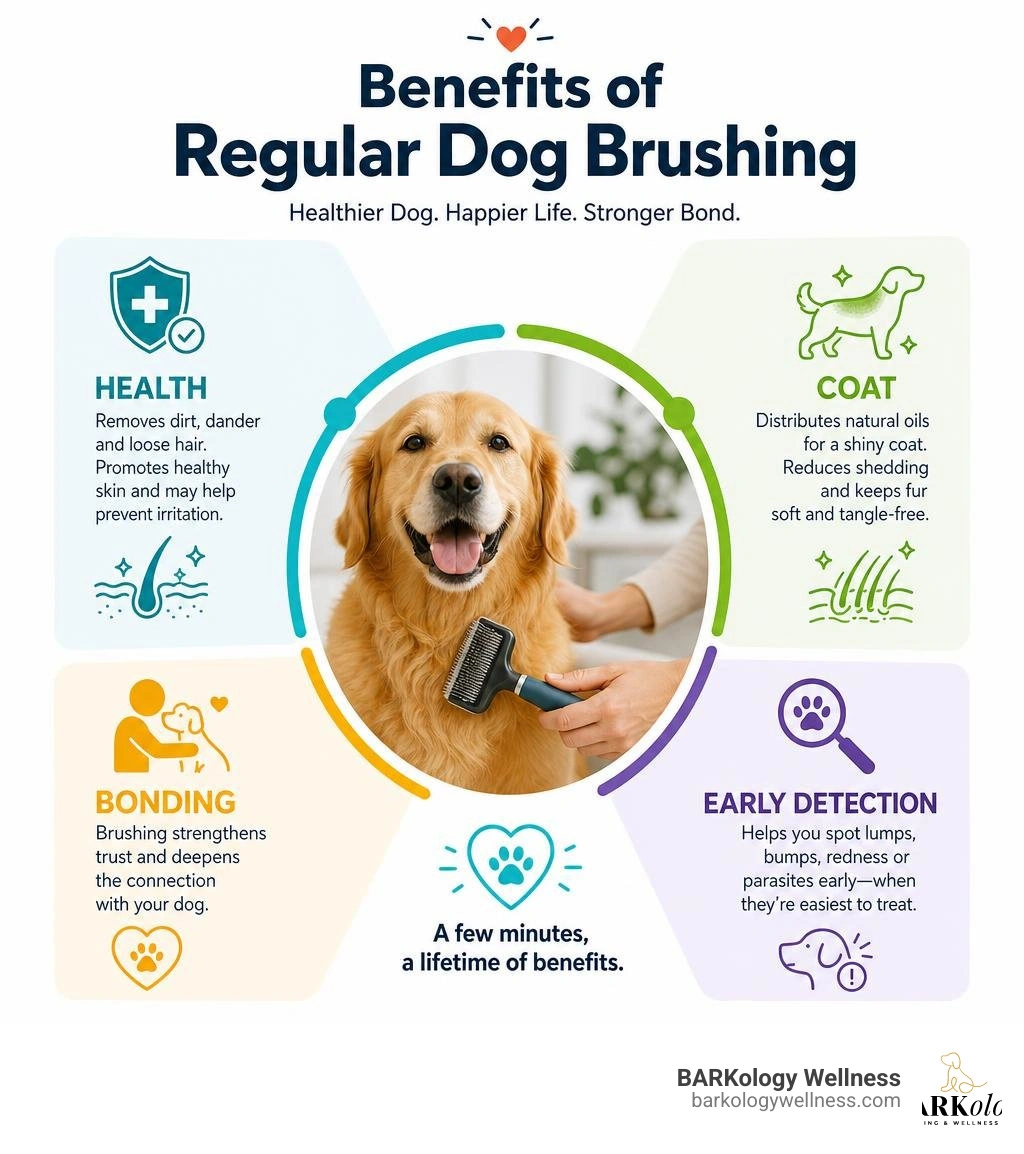
Why Regular Dog Brushing is Essential for Health and Bonding
Many pet parents view brushing as a purely cosmetic chore, something to keep the house free of tumbleweeds of drifting fur. In reality, regular coat maintenance is a foundational pillar of preventative veterinary health.
When we run a brush through our dog’s coat, we are actively participating in their physiological well-being. Brushing systematically extracts dead, trapped hair that would otherwise bind with dirt and moisture to form painful mats. This process clears the way for the skin to breathe and stimulates localized blood circulation, which delivers vital nutrients to the hair follicles.
Simultaneously, the mechanical action of the bristles distributes sebum, the skin's natural moisturizing oil, along the entire length of the hair shaft. This acts as a natural shield, locking in moisture and preventing environmental irritants from reaching the skin barrier. Without this regular distribution, oils accumulate at the base of the hair, leading to clogged pores, yeast overgrowth, and that distinct "doggy smell." To learn more about how your dog's skin functions, check out our guide on Dog Skin Care.
Beyond coat health, grooming sessions double as an early-warning system. As you work section by section, your hands and eyes are close to your dog's skin. This makes it easy to detect abnormalities like:
- Ticks, fleas, or flea dirt hidden deep in the undercoat.
- Hot spots, localized redness, or dry, flaky patches.
- Unusual lumps, bumps, or structural changes beneath the skin.
- Tender spots where your dog flinches, indicating underlying pain or joint discomfort.
According to the Dog Grooming Tips | ASPCA, maintaining a structured grooming routine also strengthens the human-animal bond. It teaches your dog to trust your touch and accept physical handling, which makes veterinary exams and professional grooming visits far less stressful.
But coat care is only half the equation. Just as we care for their fur, we must pay attention to their oral health. Did you know that over 80% of dogs over the age of three suffer from some form of periodontal disease? This condition begins as plaque, a sticky film of bacteria, which reacts with minerals in saliva to harden into tartar (calculus) in as little as 24 hours.
Clinical research shows that brushing your dog's teeth daily or every other day produces statistically significant improvements in reducing plaque, tartar buildup, and gingivitis compared to weekly or bi-weekly cleaning. At a minimum, brushing three times a week is recommended to prevent irreversible damage to the gums and bone structures supporting the teeth. By making brushing, both of the coat and the teeth, a positive, predictable ritual, you protect your companion from head to toe.
Choosing the Right Brush for Your Dog's Coat Type
Using the wrong brush on your dog is a recipe for frustration and physical pain. A tool designed to strip thick undercoat from a Siberian Husky will scrape and irritate the sensitive skin of a Italian Greyhound. Conversely, a soft grooming mitt will do absolutely nothing to untangle the dense curls of a Labradoodle.
To select the perfect tool, you must first understand your dog's coat type. For a deep dive into different fur structures, read our comprehensive resource on Dog Coat Care.
Here is a quick-reference guide to matching the right brush to your dog's coat:
| Coat Type | Key Characteristics | Recommended Primary Tool | Recommended Finishing Tool |
|---|---|---|---|
| Curly / Wool | Dense, continuously growing curls; easily mats | Slicker brush with long, flexible pins | Steel Greyhound comb |
| Double Coat | Soft, dense undercoat beneath a harsh outer guard coat | Undercoat rake | Slicker brush & metal comb |
| Smooth / Short | Flat, short fur lying close to the skin | Rubber curry brush or grooming mitt | Soft bristle brush |
| Wire | Harsh, bristly topcoat with a dense undercoat | Slicker brush or stripping knife | Medium-toothed metal comb |
| Long / Silky | Fine, flowing hair prone to tangling behind ears and legs | Pin brush with rounded tips | Fine-toothed metal comb |
When shopping for tools, look for high-quality designs that protect your dog's skin. For daily maintenance across a variety of coat lengths, a versatile option like the Daily Grooming Brush – Dandylion features long, flexible metal pins with rounded tips to detangle without scratching.
Alternatively, a double-sided option like the Dual Grooming Brush » FURminator provides a metal pin side for removing debris and detangling, and a boar's hair bristle side to smooth the coat and distribute natural oils for a healthy shine.
Selecting Tools for Curly and Double Coats
Curly and wool coats, like those found on Poodles and Doodles, do not shed in the traditional sense. Instead, loose hairs get trapped within the surrounding curls. If left unbrushed, these trapped hairs quickly bind together, creating tight mats close to the skin. To manage these high-maintenance coats, you need a high-quality slicker brush with fine, bent wire teeth. This tool reaches deep into the curls to grab loose fibers without snagging. For detailed care instructions tailored to these popular mixes, refer to our guide on Cockapoo Coat Care.
Double-coated breeds, such as Golden Retrievers, German Shepherds, and Huskies, present a different challenge. They carry a soft, insulating undercoat beneath a weather-resistant topcoat. During seasonal "blowouts" in the spring and fall, the undercoat sheds in massive clumps.
An undercoat rake is indispensable here. Featuring a single or double row of rounded metal tines, this tool glides through the topcoat to safely pull out the dead, fuzzy undercoat before it can compact. To keep active double-coated breeds looking their best, explore our specialized tips on Border Collie Coat Care.
Brushing Tools for Smooth and Wire Coats
Smooth-coated dogs, such as Boxers, French Bulldogs, and Chihuahuas, are the easiest to groom, but they still require attention. For these breeds, a rubber curry brush or silicone grooming mitt is the ultimate tool. Used in circular motions, the rubber teeth massage the skin, stimulate oil production, and attract loose, dead hairs like a magnet.
Wire-coated breeds, including many Terriers and Schnauzers, have a distinct, rough texture. Their coats require a combination of a slicker brush to remove loose undercoat and a metal comb to keep their signature facial furnishings tangle-free. For wire-coat maintenance, check out our Border Terrier Coat Care guide. For silky, long-haired breeds that require a delicate touch to avoid breaking fine hairs, read our tips on Cavalier King Charles Spaniel Coat Care.
Step-by-Step Guide: How to Brush Your Dog Without Pain
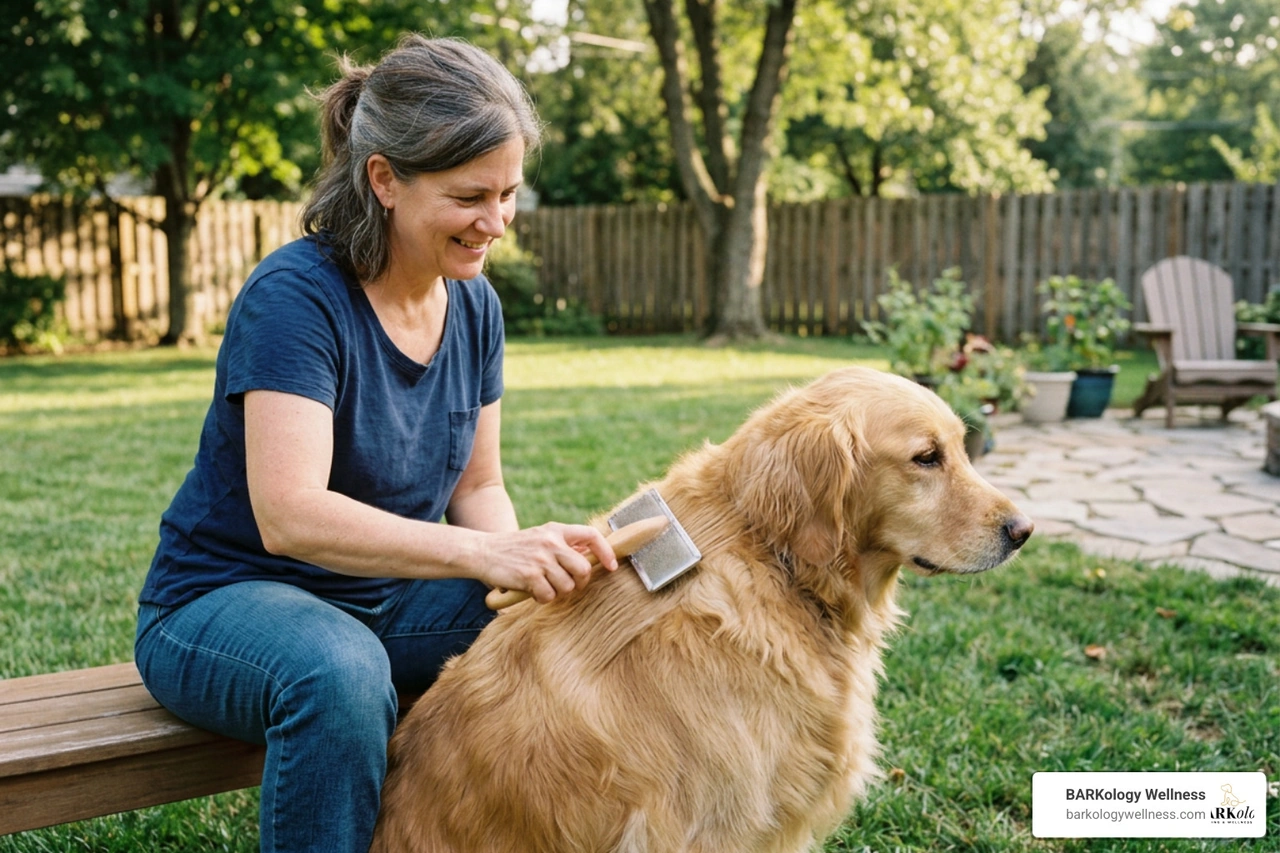
Many dogs dislike brushing because they have associated it with pain, specifically, the sharp tugging of tangled hair or the scraping of metal pins against their sensitive skin. By mastering a few professional techniques, you can transform grooming into a comfortable, spa-like experience.
The golden rule of brushing is to always work in the direction of hair growth. Brushing against the grain pulls the hair follicles backward, which is highly uncomfortable for your dog and can cause sudden, defensive movements.
To ensure you are thoroughly cleaning the coat rather than just skimming the surface, use a technique called line brushing:
- Gently part your dog's hair with your non-dominant hand, exposing a line of bare skin.
- Using your dominant hand, hold the brush and work in short, gentle strokes from the skin outward along the parted line.
- Once that section is clear, drop a new layer of hair down, part it, and repeat the process.
- Move systematically across the body in palm-sized quadrants, spending roughly 20 to 30 seconds on each section.
Safe Techniques for Pain-Free Dog Brushing
To prevent painful pulling, always use your free hand to support the base of the hair you are brushing. Place your thumb and forefinger over the root of the hair, close to the skin. This creates a physical barrier that absorbs the tension of the brush stroke, ensuring that any tugging forces are felt by your fingers rather than your dog's delicate skin.
Maintaining proper skin tension is also critical. A dog's skin is thin and highly elastic, meaning it shifts and bunches easily under pressure. If you brush over loose, folded skin, the pins can easily pinch or scrape the surface. Use your free hand to gently pull the skin taut before gliding the brush over the area.
Always use light to medium pressure. Let the design of the brush do the work; there is never a need to press the tines firmly into your dog's body. For a deeper look at the biology of canine skin and how to protect it during grooming, read our article on Dog Grooming Science.
Handling Mats, Tangles, and Sensitive Areas
Mats commonly form in high-friction "friction zones": behind the ears, in the armpits, along the flanks, on the back of the thighs, and around the collar line. These areas require a delicate approach.
If you encounter a mat, never grab household kitchen scissors to cut it out. Because a dog's skin is incredibly elastic, a tight mat will pull the skin up into the knot. Cutting the mat with scissors can easily result in a severe laceration.
Instead, follow this safe, step-by-step dematting protocol:
- Saturate the knot with a high-quality detangling spray or leave-in conditioner.
- Let the product sit for two minutes to lubricate the hair shafts.
- Hold the base of the mat firmly between your fingers to protect the skin from pulling.
- Using a metal comb, start at the very tip of the knot and gently pick it apart, slowly working your way down toward the root.
- If the mat is too dense to pick apart, use a specialized dematting tool or seek professional help.
For more expert advice on managing tough tangles safely, consult How to Brush Your Dog's Hair: 9 Vet-Approved Tips – Dogster and our guide on Advanced Dog Grooming Techniques.
Tailoring the Routine: Frequency, Puppies, and Special Needs
Grooming is not a one-size-fits-all task. Your dog's breed, age, and physical health dictate how often they need to be brushed and how you should approach each session.
During the spring and fall shedding seasons, double-coated dogs "blow" their coats. During these periods, daily brushing is essential to prevent dead hair from compacting against the skin.
Throughout the rest of the year, short-coated dogs benefit from a weekly brushing, while curly and long-coated breeds require daily attention (or a minimum of every other day) to keep tangles at bay. Neglecting a curly coat for even a few weeks can result in severe, full-body matting that requires a complete shave.
If your dog's skin looks dry, red, or flaky, adjust your brush selection to ultra-soft bristles or rubber curry brushes to avoid further irritation, and read our targeted guides on managing a Dry Skin Dog or what to do when My Dogs Coat Is Dry And Flaky.
How to Introduce Dog Brushing to a Resistant Pup
If your dog runs and hides the moment you pick up a brush, you must slowly rebuild their trust through systematic desensitization and counter-conditioning.
First, place the brush on the floor and let your dog sniff it for 30 to 60 seconds. Reward their curiosity with a high-value treat, like a smear of peanut butter on a lick mat.
Once they associate the sight of the brush with delicious rewards, pick it up and gently touch the flat, non-bristle side to their shoulder. Treat them immediately.
Slowly progress to making a single, gentle stroke with the bristles in an easy area, like the back or sides. Keep early sessions incredibly short, just two to three minutes of comfortable brushing is far better than twenty minutes of mounting stress.
Watch closely for subtle stress signals, such as:
- A stiff, frozen posture.
- "Whale eye" (showing the whites of their eyes).
- Yawning, lip-licking, or sudden panting.
- Low growling or pulling away.
If you observe any of these signs, stop immediately, reward your dog for their cooperation, and try again tomorrow at a lower intensity level.
Adjusting for Puppies, Seniors, and Health Issues
For puppies, the goal of grooming is training rather than deep cleaning. Introduce them to various tools, the sound of blow dryers, and the sensation of having their paws, ears, and tail handled from day one. Keep sessions playful, gentle, and packed with positive reinforcement.
Senior dogs require extra physical support. Aging joints can make standing for long periods painful, and conditions like muscle wasting mean their bones are closer to the surface, making firm brush strokes uncomfortable.
If you are grooming a dog with hip dysplasia or arthritis:
- Perform the grooming session on a low-height station or directly on the floor.
- Always use a thick, non-slip rubber mat or memory foam pad to give them secure traction and cushion their joints.
- Support their hindquarters with a specialized grooming sling or your arm to take the pressure off their aching hips.
- Keep sessions short (5 to 10 minutes maximum) and allow frequent rest breaks where they can lie down comfortably.
When to Stop and Call a Professional Groomer
While home maintenance is vital, there are times when DIY grooming becomes unsafe for both you and your dog.

If your dog has developed severe, pelted matting that sits tight against the skin, do not attempt to brush it out. Pelted mats cut off air circulation, trap moisture, and pull painfully on the skin with every step your dog takes. Removing these safely requires professional-grade clippers, specialized blade guards, and a highly steady, experienced hand to avoid slicing the paper-thin skin underneath.
You should also put the brush down and seek professional care if:
- Your dog shows extreme fear, growls, or attempts to bite during grooming.
- The skin beneath a mat is red, raw, oozing, or emitting a foul odor.
- Your dog has open sores, hot spots, or active skin infections that could be worsened by brushing.
- You cannot safely handle sensitive areas like the sanitary regions, face, or paws.
At BARKology South Tampa, our expert team provides a peaceful, low-stress environment where highly trained professionals can safely handle complex grooming needs, ensuring your pet leaves happy, healthy, and beautifully refreshed.
Frequently Asked Grooming Questions
How do you groom a dog with hip dysplasia?
Grooming a dog with hip dysplasia requires prioritizing joint comfort. Use a low-to-the-ground grooming area equipped with a thick, non-slip rubber mat to prevent slipping, which can cause painful joint hyper-extension. Keep sessions brief, allow your dog to sit or lie down as needed, and use a padded support harness under their belly to gently relieve pressure on their hind legs.
Should you brush a dog before or after a bath?
Always brush your dog both before and after a bath. Brushing beforehand is critical because water acts like glue on tangles; wetting a matted coat causes the hair shafts to swell and tighten, turning minor knots into tight, solid mats that are nearly impossible to remove. Once the dog is clean and dry, perform a second light brushing to remove any loose undercoat freed by the warm water and shampoo.
How often should grooming tools be replaced?
High-quality grooming tools should generally be replaced every six months to a year, depending on how frequently they are used. Inspect your brushes regularly: if you notice bent metal pins, cracked rubber backings, missing protective tips, or worn, split bristles, discard the tool immediately. Damaged pins can easily scratch your dog's skin, leading to painful scrapes and potential secondary skin infections.
Conclusion
Regular grooming is one of the greatest acts of love and preventative care you can offer your dog. By choosing the right tools, mastering gentle techniques, and establishing a consistent, positive routine, you protect your companion's physical health while building a deep bond of trust that lasts a lifetime.
When home maintenance becomes overwhelming, or when your pet deserves a touch of royal pampering, let our professional team step in. BARKology South Tampa offers luxury dog grooming and wellness services, blending cutting-edge canine science with deeply soothing, attentive care.
Ready to give your companion the ultimate grooming experience? Schedule a professional grooming session with us today and let us treat your dog to the royal care they deserve!