
Understanding the Dog De Shedder: Benefits and Differences
To understand why a dedicated dog de shedder is so effective, it helps to look at canine coat anatomy. Many popular breeds feature a double coat consisting of two distinct layers:
- Topcoat (Guard Hairs): The visible, outer layer that repels water, shields against physical debris, and protects delicate skin from UV rays.
- Undercoat: The dense, soft layer underneath that provides thermal insulation during winter and regulates temperature in warm weather.
Standard bristle brushes or pin combs only smooth the topcoat. While they sweep away surface debris, they glide right over dead fur trapped deep within the undercoat. A quality dog de shedder is engineered specifically to bypass guard hairs and reach deep down, capturing trapped undercoat fur before it drops onto your floor.
Beyond keeping your living room rug clean, regular undercoat extraction promotes healthy skin ventilation. When dead hair builds up, it traps moisture, heat, and dander, creating an environment where skin irritation and hot spots can thrive. Furthermore, hormonal factors play a massive role in coat shedding, for instance, neutered pets are likely to shed more consistently due to altered hormone levels.
| Feature / Metric | Regular Bristle / Slicker Brush | Dedicated Undercoat De-Shedder |
|---|---|---|
| Target Layer | Surface topcoat & guard hairs | Deep woolly undercoat |
| Loose Fur Removal | 20% – 40% | Up to 90% – 95% |
| Primary Function | Smoothing, shine, surface debris removal | Extracting dead undercoat, reducing dander |
| Coat Safety Mechanism | Flexible bristles glide over fur | Rounded stainless teeth or rotating pins |
| Frequency of Use | Daily or every few days | 1–2 times per week (10–20 min sessions) |
For pet parents looking for a comprehensive approach to coat health, combining a specialized tool with a targeted Dog Deshedding routine at home helps keep the fur at bay.
Best Dog De-Shedding Tool Categories Reviewed
Different dog coats require different mechanical approaches. Using a heavy serrated blade on a thin coat can cause discomfort, while a soft brush will do nothing for a thick Husky coat. Bathing your pup with a specialized Deshedding Dog Shampoo prior to grooming can loosen dead undercoat fur, making any tool you choose significantly more effective.
Stainless Steel Undercoat Rakes and Edge Tools
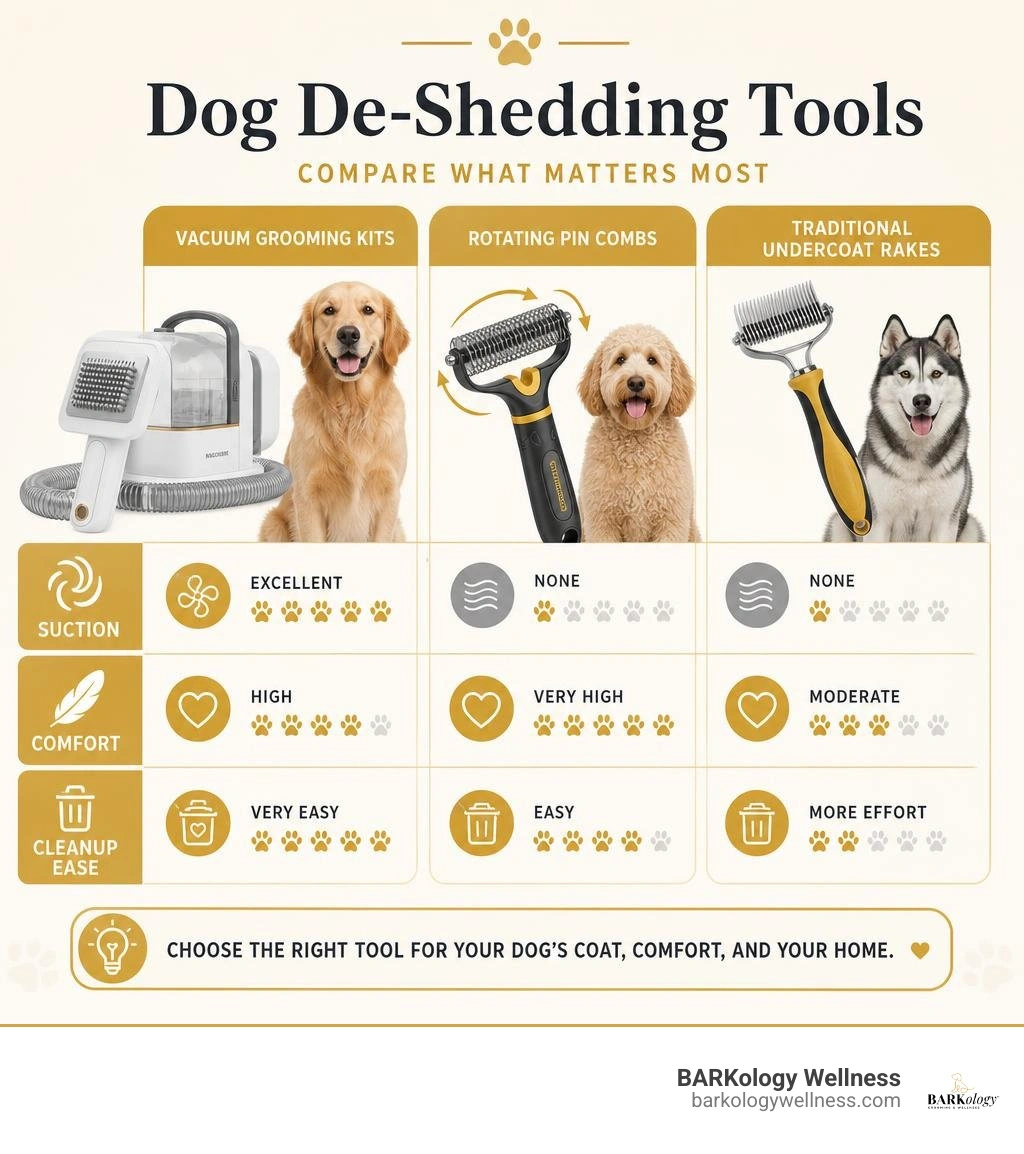
Stainless steel undercoat tools feature tightly spaced, fine teeth with integrated safety features like skin guards and curved edge geometry. Tools like the FURminator Dog XL Short Hair and FURminator Dog L Long Hair utilize specialized stainless steel edges that safely reach through the topcoat to remove loose undercoat hair without cutting guard hairs. Many high-end models feature push-button ejectors to instantly release accumulated fur.
Best Suited For:
- Heavy double-coated breeds (German Shepherds, Huskies, Golden Retrievers, Labs)
- Dogs experiencing heavy seasonal coat blowouts
Rotating Pin Combs and Dual-Sided Detanglers
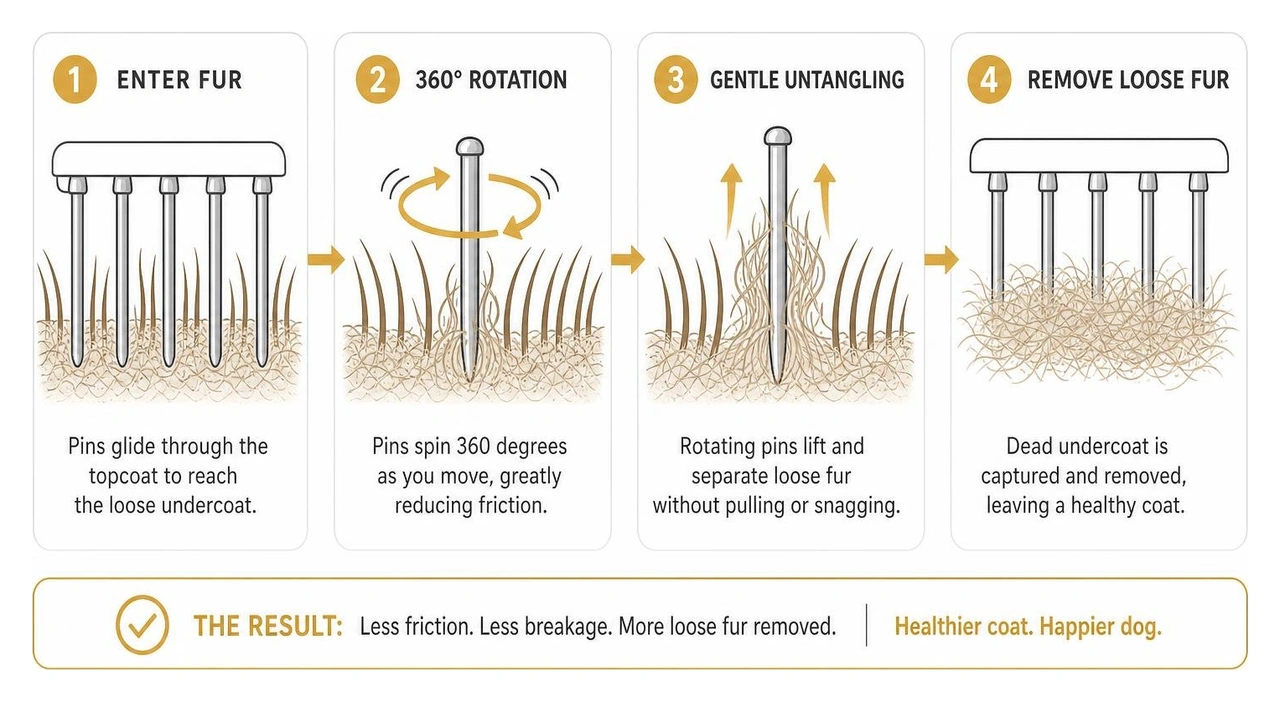
For dogs with long, wavy, or tangle-prone coats, rigid blades can pull painfully on delicate skin. Rotating pin combs, such as the Deshedding Comb for Thick Wavy Curly Coats by UNTANGLER, use smooth, cylindrical steel pins that spin 360 degrees as they pass through the fur. This motion drastically cuts down on friction, preventing coat breakage while gently lifting out dead hair.
Dual-sided tools, such as the Nuggy Shed Tamer, combine wide detangling teeth on one side with fine undercoat extraction teeth on the other.
Best Suited For:
- Thick, wavy, or curly coats (Goldendoodles, Labradoodles, Samoyeds, Bernese Mountain Dogs)
- Sensitive dogs prone to grooming anxiety
Vacuum-Assisted Grooming Kits and Self-Cleaning Slickers
Modern indoor grooming technology has brought professional salon functionality directly into the home. All-in-one systems like the Nova P1 5-in-1 Pet Grooming Vacuum Kit by furdear combine de-shedding attachments with powerful suction (up to 15,000 Pa). These systems whisk away dead fur, dirt, and dander instantly into a sealed dustbin equipped with HEPA filtration, operating at low noise levels (under 60 dB) to keep pets calm.
For quick daily touch-ups, ergonomic handheld options like the De-shedding Dog Grooming Brush by Tangle Teezer utilize two-tiered plastic teeth that conform comfortably to your palm while collecting loose topcoat and undercoat fur.
How to Select and Use a Dog De-Shedding Tool
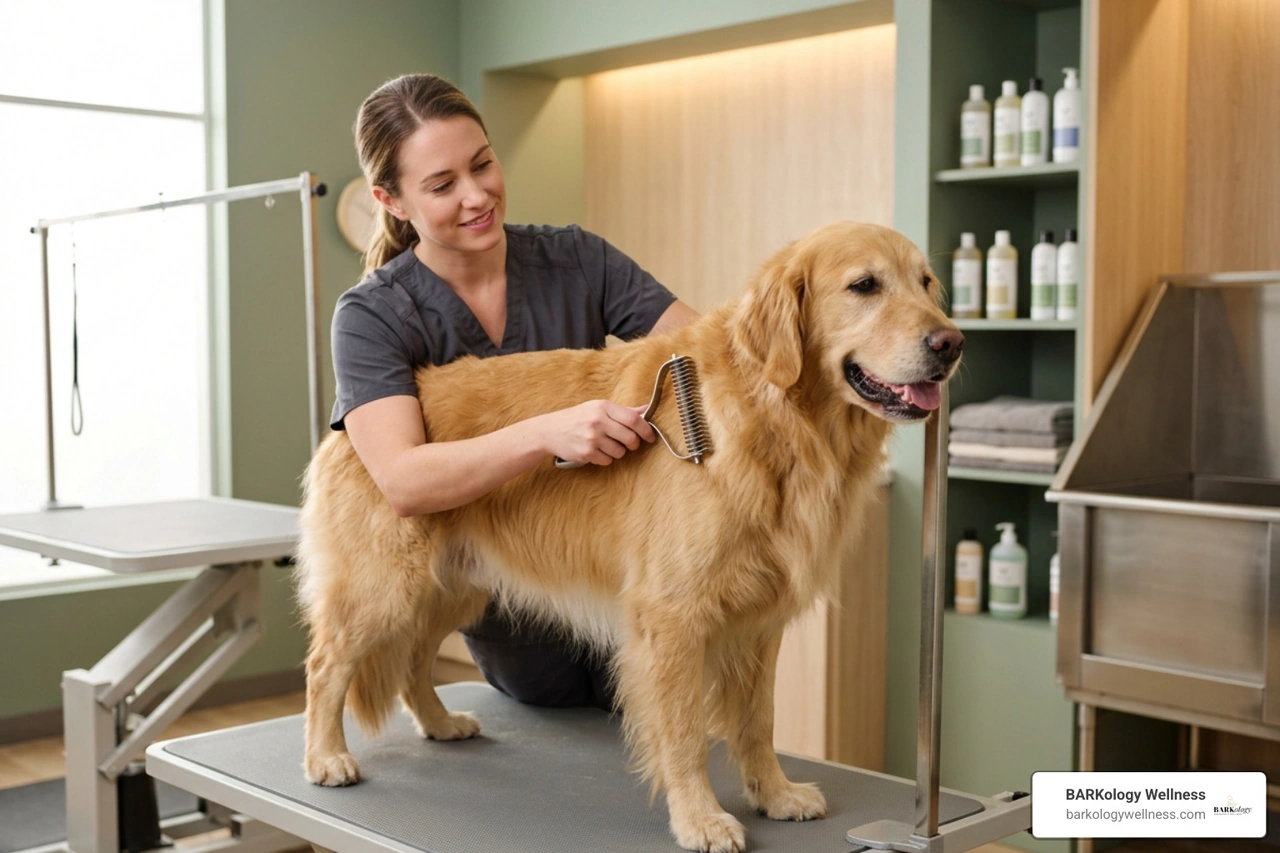
Choosing the correct tool is only half the battle, using proper technique ensures your dog enjoys a safe, pain-free grooming experience.
Key Features of a High-Quality Dog De Shedder
When evaluating options on the market, prioritize these essential features:
- Durable Blade Material: High-grade 304 stainless steel teeth resist rust, maintain edge precision, and remove accumulated dander easily when washed with warm water and mild soap.
- Ergonomic Anti-Slip Handles: Reinforced inner steel core handles with rubberized grips protect pet owners from wrist strain during long sessions.
- Safety Guards & Rounded Tips: Look for curved tooth tips, tumbled edges, or plastic skin guards to ensure metal teeth never scratch or abrade the skin.
- Self-Cleaning Mechanisms: Push-button hair ejectors save time and eliminate messy hand-clearing during grooming sessions.
Best Dog De Shedder Technique for Maximum Fur Removal
Follow this step-by-step process to get salon-quality results safely at home:
- Pre-Grooming Inspection: Always check your dog's skin first. Look for open sores, hot spots, bruises, or skin conditions. Never use a metal de-shedding tool over irritated skin or active lesions.
- Untangle First: Clear any large mats or dense tangles using a dematting comb before applying a de-shedding edge.
- Ensure a Completely Dry Coat: De-shedding tools perform best on clean, fully dry coats. Grooming right after a warm bath and blow-dry yields optimal results.
- Follow Hair Growth: Always brush gently in the direction of hair growth, from the base of the neck down to the tail.
- Use Light Pressure: Let the tool's weight do the work. Avoid pressing hard into the skin or running the tool repeatedly over the exact same spot to prevent brush burn.
- Mind Sensitive Areas: Exercise extreme caution around sensitive zones including the belly, inner legs, genitals, and ears.
Using a well-designed Deshedding Brush for Dog coats 1 to 2 times a week for 10 to 20 minutes per session keeps indoor fur under control while keeping your pup comfortable.
Frequently Asked Questions About Dog De-Shedding
What is the difference between de-shedding and dematting?
De-shedding and dematting serve two distinct grooming purposes:
- De-Shedding: Focuses on stripping loose, dead fur out of a healthy undercoat before it sheds naturally.
- Dematting: Focuses on breaking apart dense, tangled knots of hair that have already felted together. Dematting tools feature razor-sharp interior edges designed to slice through mats.
Never use a de-shedding edge to pull through a solid mat, as this will hurt your dog and damage their coat. If your dog has both mats and heavy undercoat fur, clear the mats first with a dematting rake before starting your de-shedding routine. Choosing a versatile Deshedding Dog Brush will help keep the coat free of both loose fur and small tangles.
Can de-shedding tools be used on all dog breeds?
No. Undercoat de-shedding tools should only be used on breeds that possess a true shedding coat with an undercoat layer.
Breeds that should NOT use undercoat de-shedders include:
- Poodles and Doodle mixes with single curly coats
- Maltese, Bichon Frise, and Yorkshire Terriers
- Shih Tzus and Afghan Hounds
- Any hair-coated or non-shedding breed with continuous hair growth
Using undercoat blades on single-coated or non-shedding dogs can permanently damage their guard coat and cause severe skin irritation. If you aren't sure about your pet's coat structure, scheduling a professional Deshedding at Groomer session is a great way to get personalized advice.
How often should I de-shed my dog to stop household fur build-up?
For standard maintenance, using a dog de shedder 1 to 2 times per week for 10 to 20 minutes per session is ideal. During spring and autumn coat-blowing seasons, you may increase frequency to 3 times per week.
Maintaining this routine removes up to 90–95% of loose hair at the source, preventing dead fur from accumulating on your furniture, car upholstery, and clothing.
Conclusion
Conquering the seasonal shedpocalypse doesn't require endless vacuuming or constant frustration. Equipping yourself with the right dog de shedder, whether a stainless steel undercoat rake for dense double coats, a rotating pin comb for wavy fur, or a vacuum grooming kit for mess-free sessions, transforms grooming from a chore into a relaxing bonding experience.
At BARKology Wellness, we believe every dog deserves personalized, stress-free care backed by modern coat science. If you live in South Tampa or the surrounding Tampa, FL area and want to give your pup a relaxing spa day, treat them to our Luxury Dog Grooming Services. Our professional grooming team will evaluate your dog's unique coat, perform thorough undercoat extractions, and leave their fur soft, healthy, and shed-free!