
What Every Golden Retriever Owner Needs to Know About Grooming
Dog grooming for a Golden Retriever is not optional, it is one of the most important things you can do for your dog's health and comfort.
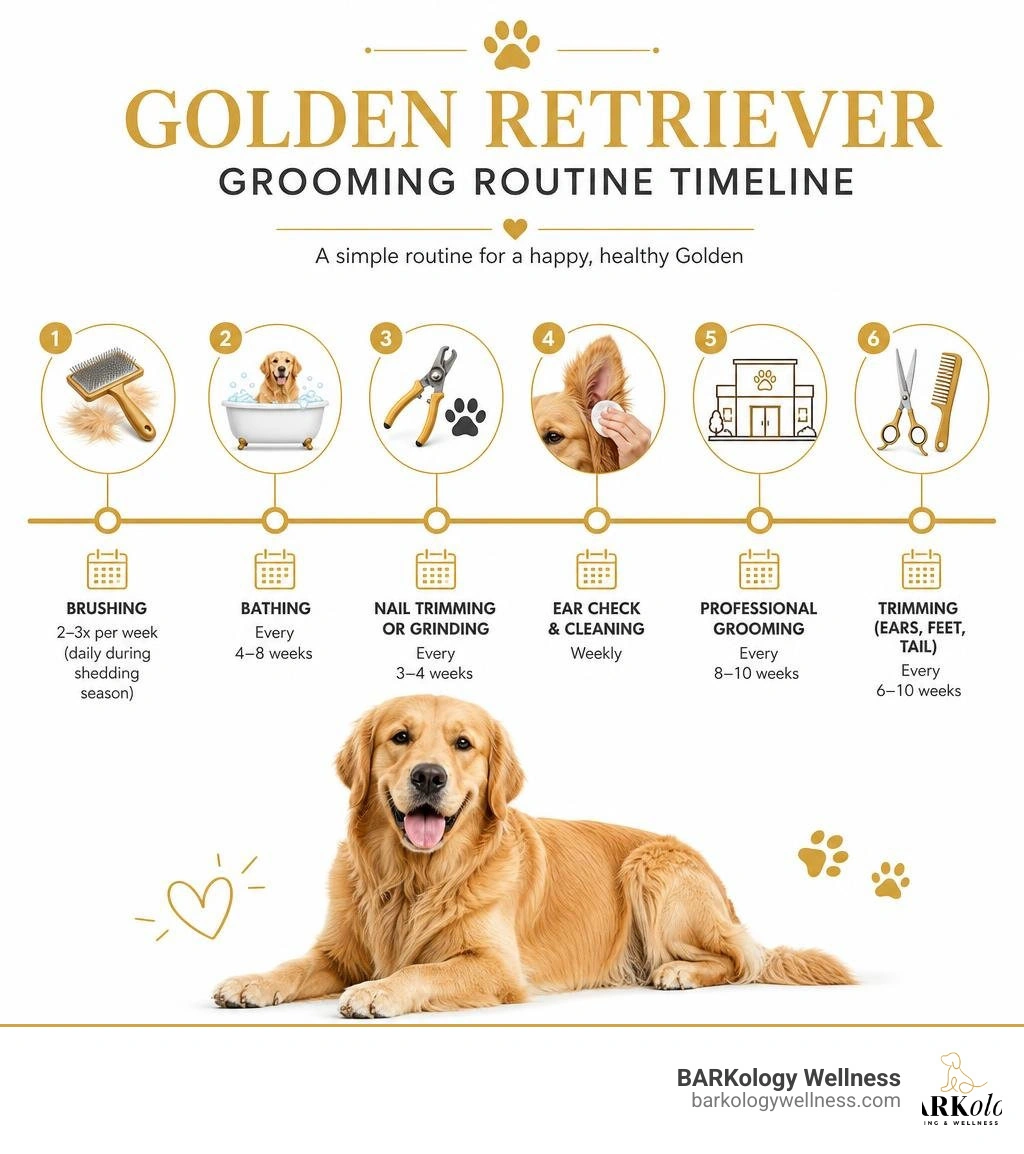
Here is a quick overview of what a proper Golden Retriever grooming routine looks like:
| Grooming Task | Frequency |
|---|---|
| Brushing | 2-3x per week (daily during shedding season) |
| Bathing | Every 4-8 weeks |
| Blow drying | After every bath (never air dry) |
| Nail trimming or grinding | Every 3-4 weeks |
| Ear check and cleaning | Weekly |
| Professional grooming | Every 8-10 weeks |
| Trimming (ears, feet, tail) | Every 6-10 weeks |
Golden Retrievers are one of America's most beloved breeds, but that gorgeous, flowing coat comes with real responsibility. They shed moderately all year and heavily once or twice a year. Without the right routine, that thick double coat can trap moisture, develop painful mats, and hide early signs of skin infections.
The good news? With the right knowledge and tools, grooming your Golden can be a rewarding experience for both of you.
I'm Nabilah Shamseddine, founder of BARKology Wellness, where I've built our grooming programs around science-based, breed-specific care, including everything that goes into dog grooming for Golden Retrievers done right. Let's walk through exactly what your Golden needs to look, feel, and live their best.
Understanding the Golden Retriever Double Coat
To understand how to care for your Golden Retriever, you must first understand the anatomy of their coat. Golden Retrievers are a double-coated breed. This means their coat is composed of two distinct layers that work together to protect them from the elements:
- The Undercoat: This is a soft, dense, downy layer of hair closest to the skin. Its primary function is insulation. It traps air close to the dog's body, keeping them warm in the winter and cool in the summer.
- The Guard Hairs (Outer Coat): This is the longer, coarser, water-resistant topcoat. It lies flat against the body, protecting the undercoat and skin from water, dirt, brambles, and ultraviolet rays.
Proper dog coat care requires managing both layers simultaneously. Because Golden Retrievers are active, water-loving dogs, their coats are highly functional. According to the How to Groom a Golden Retriever – American Kennel Club standard, a Golden's coat should wrap around the body like a functional, protective jacket.
It is also important to note that a Golden Retriever's coat does not develop properly until they are around 18 months of age. As puppies transition to their adult coats, you may notice temporary color changes (such as a light puppy coat darkening or developing a rich golden sheen) and shifts in texture. During this development phase, consistent grooming is vital to prevent the fine, changing hair from tangling.
Why You Should Never Shave a Golden Retriever
One of the most dangerous mistakes a well-meaning pet owner can make, especially during the sweltering, humid summers we experience in South Tampa, FL, is shaving their Golden Retriever.
Many owners assume that cutting the coat short will help their dog stay cool. In reality, shaving a double coat does the exact opposite. Here is why shaving is incredibly harmful:
- Destroys Thermal Regulation: The undercoat acts as a natural insulation system. When you shave the coat, you strip away the dog's built-in air conditioning. Without it, your Golden is far more likely to overheat.
- Sunburn and Heatstroke Risks: A Golden's skin is pale and highly sensitive. Shaving exposes their skin directly to harsh UV rays, drastically increasing the risk of sunburn, solar dermatitis, and heatstroke.
- Post-Clipping Alopecia ("Coat Funk"): When a double coat is shaved, the soft undercoat grows back much faster than the coarse outer guard hairs. This disrupts the coat's natural structure, often causing it to grow back patchy, coarse, velcro-like, or excessively thick. In some cases, the guard hairs may never fully recover.
- Permanent Undercoat Damage: Shaving can permanently ruin the water-repellent qualities of the top coat, leaving your dog vulnerable to moisture-related skin issues.
Unless there is a strict medical requirement (such as prep for surgery or severe, skin-level matting), clippers should never touch the body of a Golden Retriever.
The Essential Dog Grooming Golden Retriever Routine
Maintaining a Golden Retriever's coat requires a structured schedule. To keep their hair soft, shiny, and tangle-free, we recommend standard brushing 2-3 times per week year-round, and daily brushing during seasonal shedding periods (typically in the spring and fall when they "blow" their undercoat).
Baths should be scheduled every 4 to 8 weeks, depending on your dog's lifestyle and how often they play outdoors. To keep their coat in peak breed-standard shape and manage heavy undercoat build-up, Golden Retrievers should be groomed every 8 to 10 weeks by a professional.
If you are trying to decide how to balance your dog's care, here is a helpful comparison of home maintenance versus professional grooming sessions:
| Grooming Level | What is Addressed | Recommended Frequency |
|---|---|---|
| At-Home Care | Basic brushing, line brushing, detangling, weekly ear checks, and quick paw pad cleanups. | 2-3 times per week (daily during shed cycles). |
| Professional Grooming | Undercoat blowout, deep double-coat bathing, high-velocity drying, full sanitary trim, precise scissoring (ears, feet, tail), and nail grinding. | Every 8-10 weeks. |
If your dog is shedding heavily, scheduling a professional deshed golden retriever treatment can save your home from a mountain of loose fur.
Brushing Techniques for Your Dog Grooming Golden Retriever Sessions
To get the most out of your brushing sessions, you must use the correct tools. A standard bristle brush is useless because it cannot penetrate the dense undercoat. Instead, you need a high-quality slicker brush and a metal undercoat rake or greyhound comb. You can read more about selecting the right equipment in our guide to the best grooming brush for golden retriever.
When brushing, always use the line brushing technique:
- Use one hand to push a section of the coat upward, exposing the skin.
- Use your slicker brush in your other hand to brush the hair downward, working from the skin outward in the direction of hair growth.
- Move systematically across the dog's body, working in small, manageable sections.
- Follow up with a metal comb to check for hidden knots, particularly in high-friction areas like behind the ears, under the armpits, around the hindquarters, and along the leg feathers.
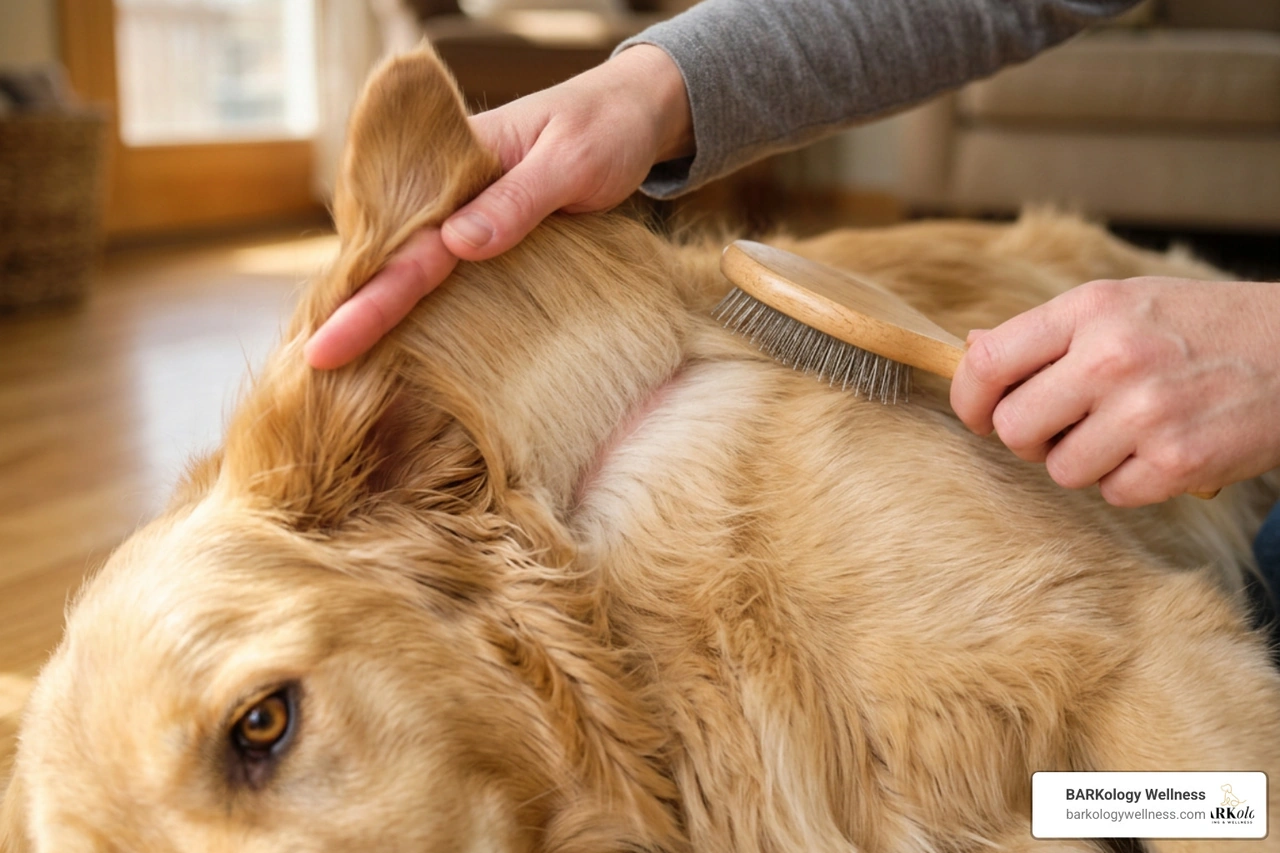
Always brush your Golden before bathing them. Water causes existing mats to tighten and shrink, making them nearly impossible to remove once wet.
Bathing and Drying: The Core of Dog Grooming Golden Retriever Care
Bathing a Golden Retriever is a physical workout. Because their outer coat is highly water-resistant, getting a double coat fully wet requires patience. You must thoroughly saturate the coat down to the skin before applying any shampoo.
Use a high-quality, soap-free canine shampoo and conditioner. Once lathered, the rinsing step is critical. Because the dense double coat easily retains shampoo residue, you must rinse the coat twice. Any leftover soap will dry out the skin, cause severe itching, and leave the coat looking dull and flaky.
After the bath, the drying phase begins. Air drying is highly discouraged for Golden Retrievers. A Golden's dense undercoat can retain moisture for 4 to 6 hours after air drying. This trapped dampness against the skin creates the perfect warm, anaerobic environment for bacterial growth, rapidly leading to acute moist dermatitis, commonly known as hot spots.
Instead, you should always blow dry your Golden from the skin out using a professional high-velocity dryer. The entire blow-drying process for a Golden Retriever will usually take at least 1.75 hours per dog, and longer for a "show" finish.
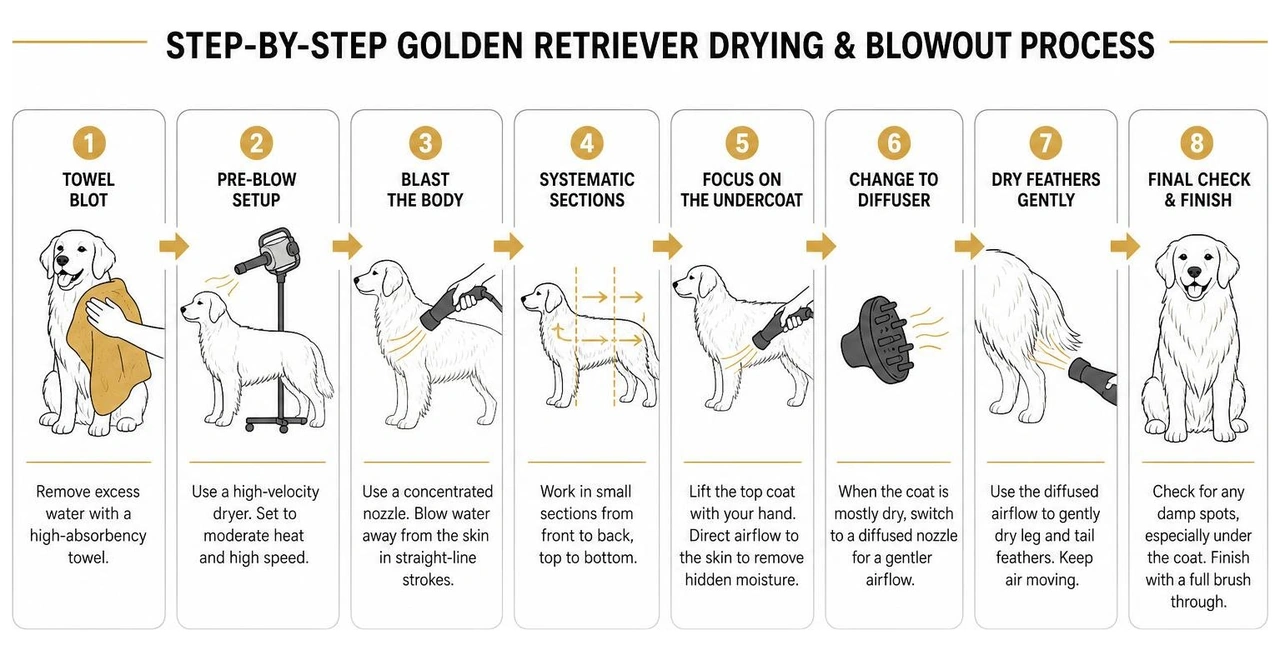
Use a concentrated nozzle to blow water away from the skin, moving in small, controlled, straight-line motions to avoid creating whip knots in the long feathering. Once the coat is mostly dry, switch to a diffused nozzle to gently dry the leg and tail feathers. For more home bathing tips, check out How to Groom a Golden Retriever at Home - Happy Wag Outfitters.
Scissoring and Trimming: Shaping the Golden Silhouette
While Golden Retrievers should never be shaved, they do require strategic trimming to maintain a neat, clean, and balanced silhouette. The goal of trimming a Golden is to achieve a natural, un-sculptured look that aligns with breed standards.
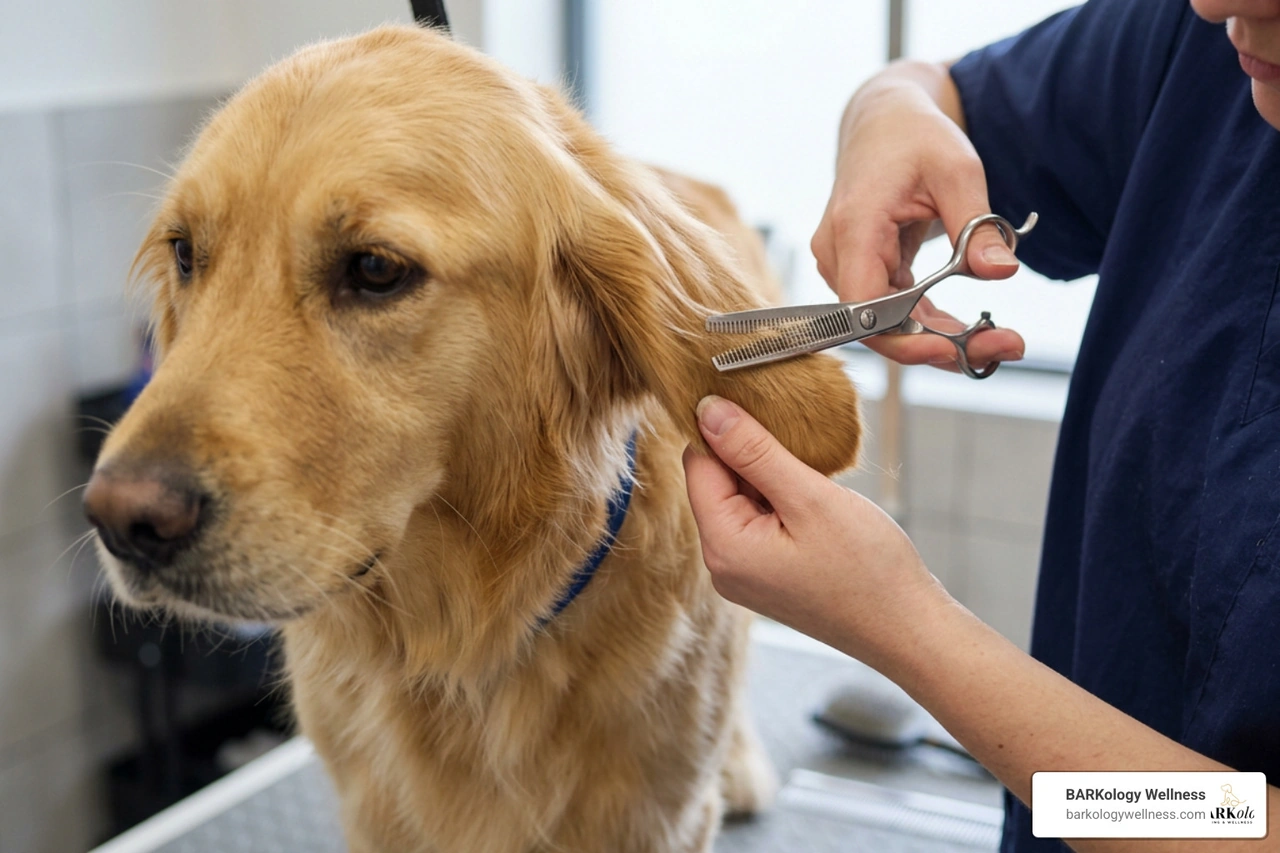
To achieve this, you should use professional thinning shears (such as 46-tooth thinning scissors) rather than straight scissors or clippers. Thinning shears blend the hair naturally, preventing blunt, harsh scissor lines.
Trimming the Ears and Neck
The ears and neck of a Golden Retriever are prone to developing wild, fuzzy hair that traps dirt and moisture.
- Ears: Hold your thinning shears vertically. Gently trim the fuzzy hair behind and around the base of the ears to thin the coat out rather than blunt-cutting it. Trim the unruly hair along the edges of the ear leather to create a clean, crisp outline while preserving the soft, gentle expression of the face. Avoid trimming the inside of the ear flap completely smooth, as this can give the face a harsh look.
- Neck: Use your thinning shears to blend the heavy chest hair into the neck, removing excess bulk while keeping the natural flow of the coat.
Grooming the Feet and Hocks
Proper foot grooming is essential for your dog's comfort and safety. In our humid Florida climate, excess hair between the paw pads traps dirt, moisture, and allergens. Furthermore, long hair on the bottom of the paws reduces traction, causing dogs to slip and slide on polished indoor floors.
- Use a small cordless clipper to trim the hair between the paw pads flush with the pads.
- Push the hair between the toes upward and use straight scissors to trim it flat and parallel to the bottom of the foot.
- Shape the top of the foot into a neat, rounded circle. The breed standard describes Golden Retriever feet as "tight and cat-like."
- Trim the hocks (the back legs from the paw up to the joint). Trim the hair on the back pasterns straight down, leaving about 3/4" to 1" of clean hair. Trimming any higher can make the legs look weak and unbalanced.
Shaping the Tail into a Perfect Fan
A Golden Retriever's tail is often referred to as their "flag." It should be shaped into a beautiful, natural-looking fan that balances the rest of their body.
- Brush the tail hair out thoroughly.
- Hold the tail straight down. Use your thumb to feel for the end of the tail bone, and use it as a safe physical guide. The tail hair should reach approximately to the dog's hocks.
- Gather the hair at the very tip of the tail, twirl it tightly, and use thinning shears to cut straight across about 1 inch past the bone. When you let go, this "twirling method" creates a perfectly natural, rounded tip.
- Hold the tail horizontally and use your thinning shears to trim the feathering in a clean, sweeping curve from the base of the tail to the tip, creating a gorgeous fan shape.
Beyond the Coat: Nails, Ears, and Skin Wellness
At BARKology Wellness, we believe that grooming is fundamentally a comprehensive health check. Every session is an opportunity to inspect your dog's body for early signs of health issues.
During grooming, we pay close attention to dog skin care and check for common issues like hot spots, dry flaky skin, and external parasites.
Additionally, because Golden Retrievers have heavy, floppy ears, they are highly prone to ear infections. Moisture easily gets trapped inside the ear canal, creating a breeding ground for yeast and bacteria. Check your dog's ears weekly. They should be pale pink, clean, and free of odor. If your Golden loves swimming, always dry the inside of their ears thoroughly with a clean cotton ball immediately afterward.
Stress-Free Nail Trimming and Grinding
Keeping your Golden's nails at a proper length is crucial for their joint health. If you can hear your dog's nails clicking on hard floors, they are too long. Nails should be trimmed or ground every 2 to 3 weeks.
Using a nail grinder is often the most comfortable, stress-free method for dogs. To prevent painful friction heat, never grind a single nail for more than 2 to 3 seconds at a time. Move between nails to let them cool down.
To safely avoid cutting the quick (the blood vessel inside the nail), use the gray dot method:
- Trim or grind the nail in tiny, 1-2 mm increments.
- Look directly at the cut face of the nail after each pass.
- As you get closer to the quick, you will see a gray, fleshy area appear.
- Stop immediately when you see a small, dark or black dot in the center of that gray area. This is the boundary of the quick.
Always keep styptic powder, cornstarch, or baking soda nearby to quickly stop the bleeding if you accidentally nick the quick. If you prefer professional help, our team offers stress-free dog nail trimming south tampa services.
Puppy Grooming and Early Acclimation
The optimal window to build grooming tolerance in puppies is wide open between 8 and 16 weeks of age. We recommend scheduling your puppy's first puppy grooming session between 8 and 12 weeks old, as soon as they have received their initial rounds of vaccinations.
At home, start acclimating your puppy immediately:
- Gently handle their paws: Touch their toes, separate their pads, and tap their nails daily to prepare them for future nail trims.
- Introduce grooming sounds: Run an electric toothbrush or a human hair dryer on a low, cool setting near them, pairing the sound with high-value treats.
- Keep sessions short: Limit initial grooming games to 2 to 5 minutes, ensuring every interaction is positive, calm, and rewarding.
Frequently Asked Questions About Dog Grooming Golden Retriever
How often should a Golden Retriever be professionally groomed?
To maintain their coat's health and prevent severe shedding, Golden Retrievers should be professionally groomed every 8 to 10 weeks. In between these visits, weekly home brushing and basic sanitary maintenance are required.
Why is air drying bad for Golden Retrievers?
Air drying traps moisture deep within the dense undercoat. This trapped dampness can take hours to dry, creating a warm, humid environment against the skin that triggers yeast infections, bacterial dermatitis, and painful hot spots.
What is the best way to stop a dog's nail from bleeding if the quick is cut?
Apply styptic powder directly to the bleeding nail with moderate pressure using a cotton swab or your finger. If you do not have styptic powder, household cornstarch or baking soda can be used as a safe alternative to help clot the blood.
Conclusion
Caring for a Golden Retriever's double coat is a labor of love, but the physical demands and precise scissoring required can sometimes feel overwhelming for busy owners.
At BARKology South Tampa, we specialize in high-end, science-based dog grooming. We understand the delicate physics of the double coat, and we never use clippers on a Golden's body. Our luxury salon provides a tranquil, one-on-one environment designed to deliver a completely stress free dog grooming experience.
Give your Golden Retriever the royal, breed-standard treatment they deserve. Book a luxury grooming session at BARKology South Tampa today and let our expert team pamper your companion from nose to tail.